In Singapore’s fast-moving business environment, “time” is not just money—it’s compliance, productivity, fairness, and trust. Whether we manage a retail chain with rotating shifts, a construction team across multiple sites, a logistics fleet that starts before sunrise, or an office workforce with hybrid arrangements, one question keeps coming back to HR and operations:
How do we capture accurate attendance—quickly, securely, and in a way that stands up to audits and payroll disputes?
That is exactly where a fingerprint time attendance system in Singapore becomes a practical advantage. And when that fingerprint capability is paired with mobile convenience, real-time dashboards, HR features, and modern security controls, it turns attendance from a daily headache into a reliable system we can build on.
In this guide, we will walk through how modern fingerprint time attendance in Singapore works, what to look for when choosing a solution, and how SmartGoGo supports accurate clock-in/clock-out and HR workflows through biometric and mobile attendance functions.
Why Fingerprint Time Attendance Still Matters in Singapore
Despite the rise of mobile apps and facial recognition, fingerprint attendance remains a favorite for many Singapore workplaces because it is:
- Fast and familiar: Users understand how to scan a fingerprint with minimal training.
- Strong against “buddy punching”: A fingerprint is tied to a real person, making it harder for someone else to clock in on their behalf (a common cause of time theft in shift-based environments).
- Operationally simple: One scan can instantly record time-in/time-out and sync to attendance reports for HR and payroll.
For businesses with shift work, frequent turnover, or many part-time staff, biometric verification provides a “no-nonsense” method to capture the truth of who was present and when.
The Compliance Reality: Employment Records and Attendance Documentation
In Singapore, employers have clear obligations to maintain employment-related records. The Ministry of Manpower (MOM) states that employers must maintain detailed employment records for employees covered by the Employment Act, and it includes requirements around what to keep and how long to keep it.
This is where attendance systems become more than convenience. A proper time attendance solution helps us:
- Keep consistent logs of working time
- Produce verifiable reports when questions arise
- Reduce disputes about lateness, overtime, or absences
- Support payroll accuracy and itemised salary documentation
When attendance is recorded manually, we are exposed to missing data, late updates, and “human error” that can become costly. A modern fingerprint time attendance solution strengthens our operational discipline and gives both management and employees more confidence in the process.
Biometric Data in Singapore: Using Fingerprints Responsibly
Because fingerprints are biometric identifiers, we must handle them responsibly. Singapore’s Personal Data Protection Commission (PDPC) has published guidance focused on the responsible use and safeguarding of biometric data in real-world applications such as facial and fingerprint recognition systems.
In practical terms, this means our attendance solution should support responsible data protection practices, including:
- Minimising unnecessary collection
- Applying proper access controls
- Protecting data in storage and transit
- Having clear operational policies for HR administrators
A strong vendor will understand that biometric attendance is not only about “capturing a scan”—it’s about managing trust and privacy properly across the organisation.
From Devices to Cloud: What “Modern” Fingerprint Attendance Looks Like
Traditional fingerprint time clocks usually work like this:
- Employee scans fingerprint on a device
- Device stores logs locally
- HR exports data at the end of the month
- Payroll team cleans the data manually
In contrast, a modern system is built for real-time operations:
- Attendance data syncs automatically
- Managers can see who is present immediately
- HR can run reports daily (not only monthly)
- Leave, payslips, and employee self-service can be integrated into one flow
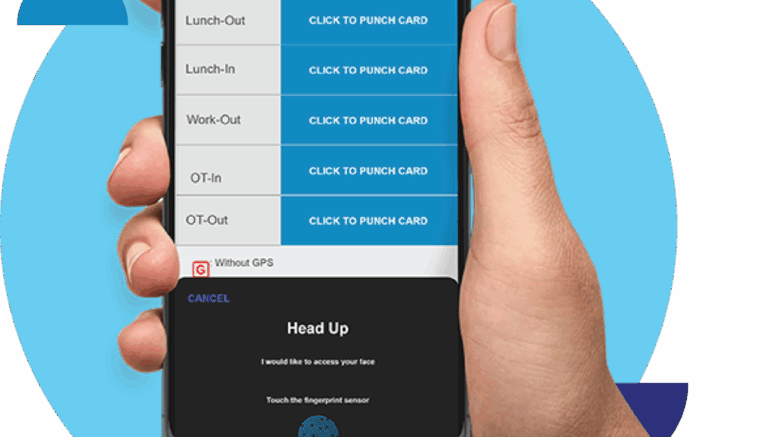
SmartGoGo is positioned in this modern category: a solution approach that supports attendance capture and HR workflows through mobile and biometric options, with features designed to reduce admin work while improving clarity for employees.
SmartGoGo for Fingerprint Time Attendance in Singapore
When we talk about fingerprint time attendance Singapore, we are not just asking for a scanner. We are asking for an attendance ecosystem that fits real working conditions: multiple outlets, remote work, split shifts, and the need to connect attendance to HR and payroll outcomes.
Based on publicly available SmartGoGo product information, SmartGoGo supports key HR and attendance functions such as:
- Clock-in attendance
- e-Leave
- e-Payslip
- Security controls including a one-device-per-account approach (helpful for reducing account sharing and unauthorised use)
- Location permission for attendance tracking, supporting workforce visibility where location verification is needed
These are not “nice-to-haves.” They address the everyday friction points we see in Singapore workplaces.
1) Accurate Clock-In/Clock-Out with Reduced Fraud
Fingerprint verification is widely valued because it reduces identity-based manipulation. When connected to an HR system, this accuracy flows directly into:
- Late/early analysis
- Overtime calculations
- Shift compliance
- Payroll correctness
2) Employee Self-Service That Reduces HR Admin
Instead of every leave request or payslip question turning into a WhatsApp message to HR, self-service features like e-Leave and e-Payslip reduce interruptions and standardise recordkeeping.
3) Security Controls That Match Operational Reality
Workforce apps can be vulnerable when users share logins or install the app across multiple devices casually. SmartGoGo’s stated “one device only can register one account” security approach helps organisations maintain tighter control over attendance accountability.
4) Location-Aware Attendance for Field Teams and Multi-Site Operations
For businesses that need to confirm where a clock-in occurred (for example: field service teams, mobile sales staff, site-based work), location-based permissions can add a layer of verification—reducing false clock-ins and improving deployment planning.
Who Needs Fingerprint Time Attendance Most in Singapore?
While nearly every business can benefit from better attendance tracking, fingerprint-based attendance tends to deliver the biggest impact for:
Retail and F&B Chains
- Multiple outlets
- High headcount variation by day/hour
- Shift rotations and frequent replacements
- Strong need to prevent buddy punching
Logistics, Warehousing, and Transport
- Early start times and changing rosters
- High overtime exposure
- Need to track punctuality and actual presence
Construction and Site-Based Work
- Worksites change
- Attendance must be traceable
- Faster roll call means more productive mornings
SMEs Scaling from Manual Systems
When a company grows, “Excel attendance” becomes fragile. A fingerprint system paired with real-time syncing and HR features helps SMEs scale without adding unnecessary HR headcount.
What to Look for When Choosing a Fingerprint Attendance Solution in Singapore
If we are selecting a system to deploy across teams, we recommend using a practical checklist:
Reliability and Speed
- Does the fingerprint scan work quickly for most users?
- Can the system handle peak-time scanning (shift change)?
Real-Time Data and Reporting
- Can managers see attendance immediately?
- Are late/absence reports easy to generate?
HR Features That Reduce Friction
- Leave application workflows
- Payslip access
- Employee self-service elements
Security and Governance
- Device/account controls
- Role-based permissions for admin users
- Clear logs for audit trails
- Responsible handling of biometric data aligned to PDPC guidance
Support and Local Understanding
Singapore HR realities are unique—public holidays, shift patterns, compliance needs, and workforce mobility. A solution provider that understands Singapore operations makes implementation smoother.
Implementation Tips: How We Roll Out Fingerprint Time Attendance Successfully
A great system still needs a good rollout plan. Here is a practical approach we use to ensure adoption:
- Define attendance rules first
- Grace periods, shift definitions, overtime rules, and who approves exceptions
- Start with a pilot
- One outlet or one department
- Validate reporting, payroll alignment, and user experience
- Train admins and supervisors
- Admins: reporting and corrections
- Supervisors: monitoring dashboards and handling disputes fairly
- Communicate privacy and purpose
- Explain why biometrics are used
- Outline how data is protected and who can access it
- Align internal practice with PDPC guidance
- Go live with a clear escalation path
- Who employees contact if they cannot scan
- What happens during device/network downtime
The ROI of Fingerprint Time Attendance in Singapore
When done properly, the value is felt quickly:
- Reduced payroll leakage from false clock-ins
- Less HR time spent chasing manual records and resolving disputes
- Better manpower planning using accurate presence data
- Cleaner records to support employment documentation practices
More importantly, transparent attendance builds workplace trust. Employees know the system is consistent. Managers know they are working with real data. Payroll becomes less stressful. That is the real payoff.
Why SmartGoGo Is a Practical Choice for Attendance Modernisation
SmartGoGo is relevant to Singapore businesses because it focuses on the real operational needs behind attendance:
- Attendance capture that supports workforce accountability
- HR self-service functions like e-Leave and e-Payslip
- Security controls to reduce misuse
- Location-permission support where verification matters
If our goal is to move beyond “just a fingerprint machine” and into a more connected workforce system, SmartGoGo is positioned as a modern approach that combines biometric and mobile convenience in one ecosystem.
Ready to Upgrade Fingerprint Time Attendance in Singapore?
If we are still relying on manual attendance, fragmented devices, or end-of-month exports, it is time to modernise. A proper fingerprint time attendance Singapore solution should give us accuracy, real-time visibility, and stronger HR workflows—without adding complexity.
SmartGoGo is designed to help organisations clock attendance efficiently while supporting HR functions that matter daily