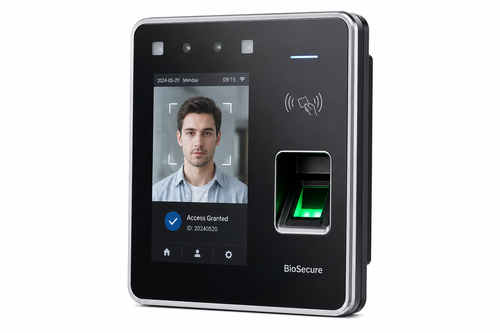
Construction sites across Singapore face growing pressure to track manpower accurately while meeting the Building and Construction Authority’s (BCA) productivity reporting requirements. A reliable biometric fingerprint and facial recognition system gives contractors a tamper-proof way to record worker attendance, block unauthorized site access, and stay compliant with BCA’s Electronic Productivity Submission System (ePSS). This guide explains how a Biometric Authentication System (BAS) works, why construction sites need one, and what to look for when choosing a system built for Singapore’s regulatory environment.
Why Construction Sites Need a Biometric Authentication System
Manual sign-in sheets and swipe cards are easy to manipulate. Buddy punching, shared cards, and illegible handwriting all make it difficult to know exactly who is on site at any given time. For large developments, this isn’t just an efficiency problem — it’s a safety and compliance risk. A biometric fingerprint and facial recognition system removes the guesswork by verifying each worker’s identity at the point of entry, ensuring that only registered, authorised personnel can access the site.
BCA ePSS Compliance Requirements
Under Regulation 10(a) of the Building Control (Buildability and Productivity) Regulations 2011, builders operating a project with a Gross Floor Area (GFA) of 5,000 sqm or more are required to install and operate a Biometric Authentication System (BAS) on site. Manpower data collected through the BAS is used to calculate project productivity and must be submitted monthly through BCA’s ePSS. From 1 May 2026, automated Construction Productivity Data (CPD) submission via SGBuildex becomes mandatory for new applicable projects, making an integrated BAS an operational necessity rather than a nice-to-have.
How Biometric Fingerprint and Facial Recognition Technology Works
A modern BAS combines multiple verification methods so that site teams can choose the option best suited to their workforce and environment.
Fingerprint Verification
Fingerprint terminals capture and store up to 8,000 templates, matching a worker’s finger against the enrolled record in under a second. It remains one of the most cost-effective and widely adopted verification methods on Singapore construction sites.
3D Facial Recognition
3D facial recognition terminals support up to 6,000 one-to-one templates and 3,000 one-to-many templates, allowing fast, contactless verification even when workers are wearing gloves or have dirty hands — a common scenario on active job sites.
Key Benefits of a Reliable BAS for Construction Sites
| Benefit | Why It Matters |
|---|---|
| Accurate manpower data | Removes buddy punching and manual entry errors from attendance records |
| BCA ePSS compliance | Generates reports in the format required for monthly productivity submission |
| Site security | Prevents unauthorised or illegal workers from entering the site |
| Faster clearance | Integrated turnstiles process up to 10 workers per minute |
| Payroll integration | Links attendance data directly to payroll, SAP, or ERP systems |
| Uninterrupted operation | Backup battery and built-in 3G module keep the system running during power outages |
BAS vs. Manual Attendance Tracking
| Factor | Manual Sign-In | Biometric Authentication System |
|---|---|---|
| Identity verification | Easily falsified | Tamper-proof fingerprint or facial match |
| BCA ePSS reporting | Manual Excel compilation | Auto-generated, upload-ready reports |
| Data accuracy | Prone to human error | Automatically calculated man-hours and man-days |
| Processing speed | Slow, especially during shift changes | Up to 10 workers cleared per minute |
| Audit trail | Difficult to verify retroactively | Searchable digital records for productivity analysis |
Best Practices for Choosing a Construction Biometric System
- Confirm the system is designed to meet BCA ePSS submission requirements out of the box
- Look for cloud-based data management so records can be accessed without maintaining on-site servers
- Check for integration options with payroll, SAP, or existing ERP software
- Choose a device with a backup battery and built-in 3G module for uninterrupted data transmission
- Prioritise systems that support both fingerprint and facial recognition for flexibility across different work conditions
- Ensure report exports are available in Excel, PDF, and Word formats for easy submission and record-keeping
Key Takeaways
A reliable biometric fingerprint and facial recognition system is no longer optional for construction sites with a GFA of 5,000 sqm or more — it’s a regulatory requirement under BCA’s Building Control regulations. Beyond compliance, it strengthens site security, eliminates manual attendance errors, and gives project managers accurate, real-time visibility into manpower usage.
Conclusion
Choosing the right Biometric Authentication System means balancing regulatory compliance, site security, and day-to-day operational efficiency. A well-implemented BAS reduces administrative workload, prevents unauthorised site access, and keeps your project aligned with BCA’s ePSS and upcoming SGBuildex requirements. Smart Touch’s biometric fingerprint and facial recognition solutions are purpose-built for Singapore’s construction industry, combining accurate identity verification with automated compliance reporting.
Frequently Asked Questions
What is a Biometric Authentication System (BAS)?
A BAS is a site attendance system that uses fingerprint or facial recognition to verify worker identity, track man-hours, and generate the manpower data required for BCA’s ePSS submissions.
Is a BAS mandatory for all construction sites in Singapore?
It is mandatory for projects with a GFA of 5,000 sqm or more, submitted for planning permission from 1 November 2014 onwards, under Regulation 10(a) of the Building Control (Buildability and Productivity) Regulations 2011.
Can a BAS integrate with payroll software?
Yes. A reliable BAS can be linked to payroll, SAP, or other ERP systems so that verified attendance data flows directly into pay calculations.
How accurate is facial recognition in outdoor construction environments?
Modern 3D facial recognition terminals are designed to handle variable lighting and site conditions, offering reliable contactless verification even when workers’ hands are dirty or gloved.
What happens if a construction site does not comply with BCA’s ePSS requirements?
Non-compliance can affect a builder’s productivity assessment and Buildability and Constructability clearance applications, which rely on accurate CPD records.
Learn more about this product—click here: https://smartouch.com.sg/bas/
Smart Touch technology pte ltd , www.smartouch.com.sg +65-63964767, sales@smartouch.com.sg , www.smartouch.com.my +607-3889903 sales@smartouch.com.my