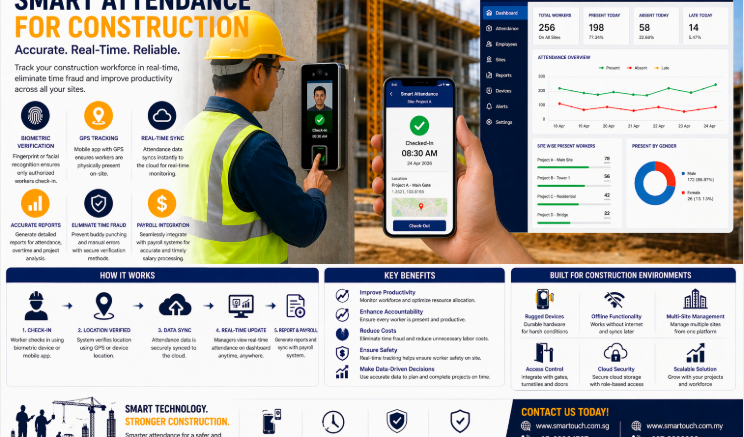
A heavy-duty biometric authentication system is fast becoming the backbone of site security for factories, warehouses, and commercial buildings across Singapore. As unauthorised access, buddy-punching, and credential sharing continue to expose businesses to safety and financial risk, organisations need a way to confirm identity that cannot be borrowed, lost, or faked. That is exactly what a robust biometric authentication system delivers: verified, real-time identity checks at every entry point.
In this guide, we break down what a heavy-duty biometric authentication system (BAS) is, why it matters for Singapore businesses, the features that separate industrial-grade systems from consumer-grade ones, and how to deploy one successfully at your site.
What Is a Heavy-Duty Biometric Authentication System?
A heavy-duty biometric authentication system uses unique physical traits — fingerprints, facial features, or a combination of both — to verify a person’s identity before granting access to a site, room, or piece of equipment. Unlike standard consumer devices, “heavy-duty” systems are engineered for demanding environments: dusty factory floors, outdoor gates, high foot-traffic lobbies, and 24/7 operational sites.
These systems typically combine rugged hardware (weatherproof housings, anti-tamper casings) with cloud-based or on-premise software that logs every access attempt, flags anomalies, and integrates with existing security infrastructure such as CCTV and turnstiles.
Why Singapore Businesses Need a Heavy-Duty Biometric Authentication System
Rising Security Risks at Industrial and Commercial Sites
Construction sites, logistics hubs, and manufacturing plants are frequent targets for unauthorised entry, theft, and workplace incidents involving untrained personnel. A biometric authentication system closes this gap by ensuring only verified, authorised individuals can enter restricted zones — no shared cards, no cloned fobs, no guesswork.
Compliance and Workforce Accountability
Singapore’s regulatory environment increasingly expects employers to maintain accurate, auditable attendance and access records, particularly for foreign worker dormitories, construction sites, and BCA-regulated premises. A biometric authentication system automatically generates tamper-proof logs, making audits and compliance reporting significantly easier.
Key Features of a Reliable BAS Solution
| Feature | Why It Matters |
|---|---|
| Multi-modal verification (fingerprint + facial) | Reduces false rejections and adapts to different site conditions |
| IP-rated, rugged hardware | Withstands dust, humidity, and outdoor installation |
| Cloud dashboard with real-time alerts | Lets site managers monitor access remotely, from any device |
| Integration with CCTV and turnstiles | Creates a unified, end-to-end security ecosystem |
| Audit-ready access logs | Simplifies compliance reporting and incident investigations |
Key Benefits of Upgrading to a Heavy-Duty Biometric Authentication System
Businesses that switch from cards or PIN codes to a heavy-duty biometric authentication system typically see improvements across several areas. Security teams gain a single source of truth for who entered a site and when, while HR and operations teams benefit from more accurate attendance data. Because biometric credentials cannot be shared or duplicated, “buddy punching” and unauthorised sub-contractor access are effectively eliminated. Maintenance overheads also drop, since there are no physical cards or fobs to replace, reissue, or deactivate.
Best Practices for Deploying a Biometric Authentication System
A successful rollout depends on more than just the hardware. Follow these steps to get the most out of your investment.
- Audit your site’s entry points — identify every door, gate, and restricted zone that needs coverage.
- Choose IP-rated hardware for any outdoor or semi-outdoor installation to avoid weather-related downtime.
- Plan for network redundancy so access control continues functioning even during connectivity interruptions.
- Enrol users in batches with clear instructions to minimise onboarding delays.
- Integrate with existing systems such as HR software, CCTV, and visitor management for a unified security posture.
- Review access logs regularly to catch anomalies early and refine access permissions over time.
BAS vs Traditional Access Control
| Criteria | Traditional Cards/PIN | Heavy-Duty BAS |
|---|---|---|
| Credential sharing risk | High | Eliminated |
| Durability in harsh environments | Moderate | High (IP-rated) |
| Audit trail accuracy | Manual, error-prone | Automated, tamper-proof |
| Ongoing costs | Card replacement, admin time | Minimal after installation |
| Remote monitoring | Limited | Real-time, cloud-based |
Key Takeaways
A heavy-duty biometric authentication system gives Singapore businesses a durable, accurate, and audit-ready way to secure their sites. By replacing cards and PINs with verified biometric checks, organisations reduce security risks, improve compliance, and gain real-time visibility into who is accessing their premises at all times.
Conclusion
Securing an industrial or commercial site in Singapore no longer needs to rely on credentials that can be lost, shared, or faked. A heavy-duty biometric authentication system delivers rugged, reliable, and fully auditable access control — purpose-built for demanding environments. Whether you manage a factory, warehouse, or multi-tenant facility, upgrading to a biometric authentication system strengthens your security posture while simplifying compliance and day-to-day operations.
If you are ready to protect your site with a solution designed for tough, real-world conditions, Smart Touch’s biometric authentication system is built to deliver.
Learn more about this product—click here: https://smartouch.com.sg/bas/
Frequently Asked Questions
1. What makes a biometric authentication system “heavy-duty”?
Heavy-duty systems use rugged, IP-rated hardware designed to withstand dust, humidity, outdoor exposure, and high-traffic use — unlike standard indoor or consumer-grade devices.
2. Can a heavy-duty BAS integrate with our existing CCTV and turnstiles?
Yes. Most modern biometric authentication systems are designed to integrate with CCTV, turnstiles, and visitor management platforms for a unified security setup.
3. Is biometric data stored securely?
Reputable systems encrypt biometric templates and store them securely, either on-premise or in the cloud, in line with data protection best practices.
4. How long does installation typically take?
Installation timelines vary by site size, but most single-site deployments can be completed within a few days, including hardware setup and user enrolment.
5. Does a biometric authentication system work during power or network outages?
With proper redundancy planning — such as local caching and backup power — access control can continue functioning even during short interruptions.
Learn more about this product—click here: https://smartouch.com.sg/bas/
Smart Touch technology pte ltd , www.smartouch.com.sg +65-63964767, sales@smartouch.com.sg , www.smartouch.com.my +607-3889903 sales@smartouch.com.my