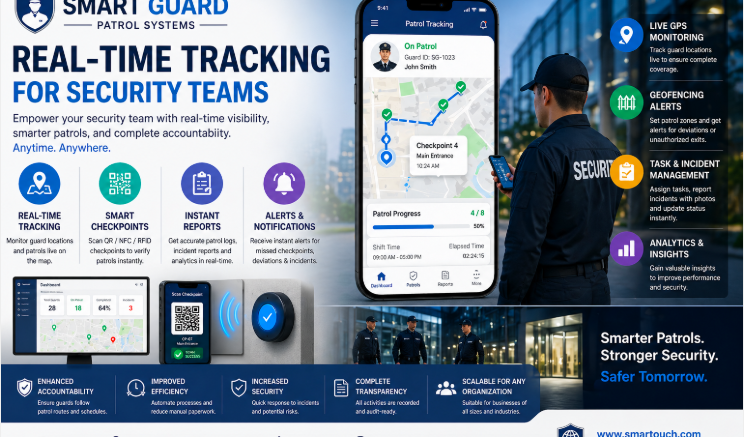
Security officers walking the same route night after night can quietly slip into habits that undermine the whole point of a patrol: skipped checkpoints, rushed rounds, or logs filled in from memory after the shift ends. A guard patrol system fixes this by requiring officers to scan a checkpoint at each stop, creating a verifiable, time-stamped record of every round. This guide covers what a guard patrol system does, what to check for when choosing one, and why more security teams across Singapore are moving away from paper logbooks.
Why Manual Guard Patrol Logs Fall Short
Paper checklists rely entirely on trust, and trust is hard to verify after the fact. Supervisors reviewing a logbook the next morning have no way of confirming that a guard actually walked past every checkpoint at the recorded time, or whether the entries were filled in all at once at the end of the shift.
Falsified or Skipped Checkpoints
Without a way to verify presence at each location, it is easy for rounds to be shortened or skipped entirely during quiet shifts. This creates real security gaps, particularly in large properties, construction sites, or industrial estates with multiple entry points.
No Real-Time Visibility for Supervisors
With a paper system, supervisors only find out about a missed checkpoint or an incident the next day, long after it matters. There is no way to know in real time whether a guard is on schedule, delayed, or has stopped moving altogether.
What Is a Guard Patrol System?
A guard patrol system is a digital tool that verifies a security officer’s presence at designated checkpoints using NFC tags, QR codes, or GPS location data, usually scanned with a handheld device or smartphone app. Each scan is time-stamped and uploaded automatically, giving supervisors a complete, tamper-resistant record of every patrol round.
How Checkpoint Scanning Works
Small NFC tags or QR codes are installed at each checkpoint along the patrol route, such as stairwells, loading bays, and perimeter fences. When a guard scans a tag, the system logs the exact time and location, and any missed or delayed checkpoint triggers an alert to the supervisor.
Guard Patrol System Checklist: What to Look For
Not all guard patrol systems offer the same level of detail or reliability. Use this checklist when evaluating options for your site.
Checkpoint Coverage and Scan Verification
Confirm the system supports enough checkpoints for your site’s layout and that each scan is verified against GPS or NFC data, not just manually entered. This prevents guards from marking a checkpoint complete without actually being there.
Real-Time Alerts and Incident Reporting
Look for a system that sends instant alerts when a checkpoint is missed, a round runs late, or a guard reports an incident directly from the field. Faster notification means faster response when something actually goes wrong.
GPS Tracking and Route Compliance
GPS tracking confirms that guards are following the assigned route rather than taking shortcuts, and gives supervisors a live map view of where every officer is at any given moment.
Reporting and Audit Trail
A good system generates clean, exportable reports that can be shared with clients or used during audits, showing exactly when each checkpoint was scanned across any date range.
Benefits of a Guard Patrol System
Beyond checkpoint verification, a digital patrol system changes how security teams operate day to day.
Improved Accountability
Guards know their rounds are being tracked accurately, which naturally improves consistency and discourages skipped checkpoints. Supervisors, in turn, have objective data rather than a guard’s word to rely on.
Faster Incident Response
When an issue is flagged from the field in real time, supervisors and response teams can act immediately instead of discovering the problem the next day. This is especially valuable for construction sites, warehouses, and residential estates where fast response matters.
Client-Ready Reporting
Security contractors managing patrols for external clients can generate professional, timestamped reports on demand, which builds trust and simplifies contract renewals.
Who Needs a Guard Patrol System?
Guard patrol systems suit any site where security officers cover multiple checkpoints, including residential estates, industrial parks, construction sites, warehouses, and commercial buildings. Security agencies managing patrols across several client sites benefit particularly from the centralised reporting a digital system provides.
Getting Started With Smart Touch Technology
Smart Touch Technology sets up guard patrol systems for security teams and property managers across Singapore, including checkpoint installation, mobile app configuration, and supervisor dashboard setup. We tailor the checkpoint layout to your site so patrol routes match how your property actually needs to be secured.
Conclusion
A guard patrol system replaces guesswork with verified data, giving supervisors real-time visibility and clients confidence that patrols are actually being carried out as scheduled. For any Singapore property or security contractor still relying on paper logs, it is one of the most direct upgrades to both accountability and response time.
Frequently Asked Questions
1. What is a guard patrol system?
A guard patrol system is a digital tool that verifies a security officer’s presence at checkpoints using NFC, QR codes, or GPS, replacing manual paper logbooks with a time-stamped digital record.
2. Do guards need special training to use it?
No. Most systems use a simple scan-and-go process that guards can learn in minutes, usually through a smartphone app or a small handheld device.
3. Can supervisors track guards in real time?
Yes, most guard patrol systems include a live dashboard showing each officer’s location, completed checkpoints, and any missed or delayed rounds as they happen.
4. How many checkpoints can a site have?
This depends on the provider and package chosen, but most systems support enough checkpoints to cover even large industrial or residential sites with multiple buildings.
5. How long does installation take?
Checkpoint installation and app setup are typically completed within a day or two, depending on the size of the site and the number of checkpoints required. Many providers also offer a phased rollout, letting larger properties bring checkpoints online building by building rather than switching over all at once.
Need more information about the product? Click here: https://smartouch.com.sg/guard-patrol-system/
Smart Touch technology pte ltd , www.smartouch.com.sg +65-63964767, sales@smartouch.com.sg , www.smartouch.com.my +607-3889903 sales@smartouch.com.my