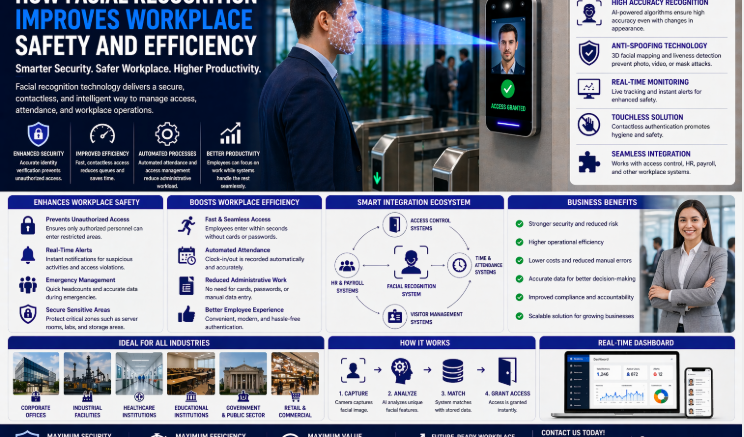
Workplace security starts at the door. Traditional lock-and-key systems offer little visibility into who enters a building and when, making it difficult to prevent unauthorised access or investigate incidents after the fact. An advanced door access control system replaces physical keys with digital credentials, giving Singapore businesses centralized control over every entry point. This guide covers what a door access control system is, its key features, and how to choose the right one for your workplace.
What Is a Door Access Control System?
A door access control system is a security solution that manages entry to a building or specific rooms using digital credentials such as key cards, PIN codes, mobile credentials, or biometric data like fingerprints and facial recognition. Instead of relying on physical keys, employees authenticate at each door, and the system logs every entry attempt in real time.
For workplaces, this means administrators can grant or revoke access instantly, restrict certain areas to authorised personnel only, and generate detailed audit trails without relying on manual sign-in sheets.
Key Features of an Advanced Door Access Control System
Multi-Factor Authentication
Advanced systems combine two or more credential types, such as a card plus a PIN, or facial recognition plus a mobile app, to reduce the risk of unauthorised entry through lost or shared credentials.
Centralized Access Management
A central dashboard allows security teams to manage permissions across multiple doors and buildings from one place, set time-based access schedules, and receive alerts for unusual activity such as repeated failed entry attempts.
How to Choose the Right System for Your Workplace
- Map your entry points. Identify main entrances, server rooms, and other sensitive areas that need controlled access.
- Decide on credential types. Choose between card-based, PIN-based, mobile, or biometric access based on your security needs and budget.
- Check integration capabilities. Ensure the system can integrate with your existing CCTV, visitor management, or HR systems.
- Plan for scalability. Select a system that can expand to additional doors or offices as your business grows.
- Set access permission tiers. Define which employees or roles can access which areas and during what hours.
- Train staff and test the system. Run a trial period before full deployment to catch any configuration issues.
Door Access Control vs Traditional Lock and Key
| Aspect | Traditional Lock and Key | Advanced Door Access Control |
|---|---|---|
| Access tracking | No record of entry | Real-time digital logs |
| Revoking access | Requires rekeying locks | Instant deactivation in the system |
| Multiple entry points | Separate keys needed | Centralized management |
| Security incidents | Difficult to investigate | Audit trail available |
| Scalability | Limited and costly | Easily expandable |
Best Practices for Workplace Security
- Restrict high-security areas, such as server rooms, to a limited list of authorised personnel.
- Review access logs periodically to spot unusual entry patterns.
- Deactivate credentials immediately when an employee leaves the company.
- Combine door access control with CCTV for a more complete security picture.
- Schedule regular firmware updates and maintenance checks on access control hardware.
Compliance and Data Considerations
Since door access control systems collect entry data and, in some cases, biometric information, businesses should ensure their vendor follows data protection best practices, including encrypted storage and restricted access to personal data. Employers should also inform staff about what data is collected and how it is used, in line with Singapore’s data protection requirements.
Key Takeaways
- Door access control systems replace physical keys with digital credentials for better security and tracking.
- Multi-factor authentication and centralized management are core features of advanced systems.
- Choosing the right system involves mapping entry points, credential types, and integration needs.
- Regular audits and prompt credential deactivation strengthen workplace security over time.
Conclusion
An advanced door access control system gives Singapore workplaces the visibility and control needed to secure their premises effectively. By moving beyond traditional locks to digital credentials and centralized management, businesses can respond faster to security incidents, restrict sensitive areas, and maintain accurate audit trails. Careful planning around credential types, integrations, and staff training ensures the system delivers long-term value.
Frequently Asked Questions
What credential types are most secure for door access control?
Multi-factor options, such as combining a card with a PIN or biometric verification, generally offer stronger security than a single credential type alone.
Can door access control systems work with existing office doors?
Most systems can be retrofitted to existing doors, though installation requirements vary depending on door type and material. A vendor assessment can confirm compatibility.
How quickly can access be revoked for a former employee?
With a centralized system, administrators can deactivate a credential instantly from the dashboard, unlike physical keys which require rekeying locks.
Is biometric data safe to use for workplace access control?
Reputable systems encrypt and securely store biometric data, but businesses should confirm their vendor’s data protection practices before deployment.
Want to know more about this product? Click here: https://smartouch.com.sg/face-and-door-access/
Smart Touch technology pte ltd , www.smartouch.com.sg +65-63964767, sales@smartouch.com.sg , www.smartouch.com.my +607-3889903 sales@smartouch.com.my