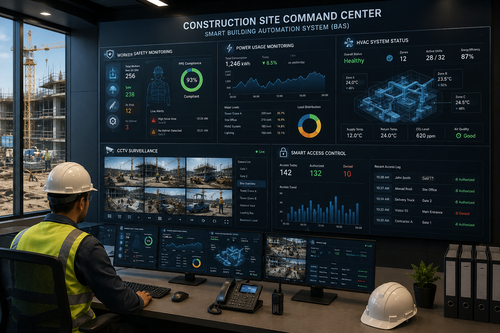
Construction sites in Singapore are high-value, high-risk environments where unauthorised access can lead to theft, safety violations, and costly project delays. A reliable biometric authentication system (BAS) gives site managers a fast, tamper-proof way to confirm exactly who is entering a work site, when, and for how long. As Singapore’s Building and Construction Authority pushes for tighter site security and digital record-keeping, more contractors are replacing paper logbooks and shared access cards with biometric verification. This guide walks through what a biometric authentication system for construction actually does, the features that separate a reliable supplier from the rest, and how to choose the right partner for your project.
Why Construction Sites Need a Biometric Authentication System
Traditional access control on construction sites relies on shared access cards, PIN codes, or paper sign-in sheets. All three are easy to abuse. Cards get lent to unauthorised workers, PINs get shared over messaging apps, and paper logs are routinely filled in after the fact rather than in real time.
A biometric authentication system removes this weak link entirely. Because fingerprints and facial features cannot be borrowed, shared, or forgotten at home, every entry event is tied to a specific individual. This matters for three practical reasons on Singapore worksites: manpower compliance, safety accountability, and insurance claims.
Under Ministry of Manpower guidelines, main contractors are responsible for knowing exactly who is on site at any given time, including subcontractors and foreign workers. A biometric authentication system produces a verifiable, timestamped record that satisfies audits far more convincingly than a signature on a clipboard. If an incident occurs, that same record becomes critical evidence for insurers and investigators.
Beyond compliance, site theft is a real and expensive problem. Tools, materials, and equipment left in unsecured zones are frequent targets, and shared credentials make it almost impossible to trace who had access at the time of a loss. Biometric verification closes that gap by linking every access event to one verified person, not a card that could be in anyone’s pocket.
Key Features to Look for in a BAS Supplier
Not all biometric authentication systems are built for the realities of a construction site. Before signing with a supplier, check that the system covers the following.
Fingerprint, Face, and Multi-Modal Recognition
Workers on construction sites often have worn, dry, or dirty fingertips from manual labour, which can reduce fingerprint match rates. Look for a BAS supplier that offers multi-modal authentication, combining fingerprint and facial recognition, so the system can fall back to face verification when a fingerprint read fails.
Ruggedized Hardware for Outdoor Site Conditions
Site entrances are rarely climate-controlled. Terminals need to be IP65 or higher rated for dust and water resistance, function clearly in direct sunlight, and tolerate the temperature swings common in Singapore’s outdoor and semi-outdoor work zones.
Integration With Time Attendance and Payroll
A biometric authentication system should not exist in isolation. The best suppliers offer integration with time and attendance software, payroll systems, and manpower reporting tools, so verified entry data automatically feeds into workforce management without manual re-entry.
Local Support and Warranty Coverage
Construction schedules cannot pause for equipment downtime. A supplier with a local Singapore support team, spare-part availability, and a clear service-level agreement will matter far more over a two-year project than a slightly lower upfront price.
Biometric Authentication vs Traditional Access Control
The table below compares the two approaches across the factors that matter most to site managers.
- Identity verification — Biometric Authentication System: Confirms the actual individual; Card or PIN-Based Access: Confirms possession of a card or code
- Buddy punching risk — Biometric Authentication System: Effectively eliminated; Card or PIN-Based Access: Common and hard to detect
- Lost credential risk — Biometric Authentication System: None, nothing to lose or duplicate; Card or PIN-Based Access: Cards lost, stolen, or shared
- Audit readiness — Biometric Authentication System: Automatic, timestamped, tamper-proof; Card or PIN-Based Access: Manual, easy to falsify
- Long-term cost — Biometric Authentication System: Lower after initial hardware investment; Card or PIN-Based Access: Recurring cost of card replacement
- Weather and dust resistance — Biometric Authentication System: Depends on rated hardware; Card or PIN-Based Access: Generally unaffected by weather
Key Benefits of a Biometric Authentication System
- Accurate, real-time headcount for every zone on site
- Elimination of buddy punching and time theft
- Faster entry and exit during shift changes
- Verifiable compliance records for MOM and BCA audits
- Reduced administrative workload for site admin staff
- Stronger deterrence against unauthorised access and theft of tools or materials
- Centralised data that supports multi-site reporting for larger contractors
How to Choose the Right BAS Supplier in Singapore
- Confirm the supplier has experience deploying on active construction sites, not just offices.
- Ask for references from projects of a similar scale and duration.
- Verify hardware ratings for dust, water, and temperature tolerance.
- Check what happens during a power or network outage, and whether the system fails open, fails closed, or caches data locally.
- Review the integration options with your existing time attendance, payroll, or ERP systems.
- Confirm local support response times and warranty terms, since site downtime is costly.
- Request a short on-site trial before committing to a full rollout across multiple gates.
Deployment Timeline and Cost Considerations
Most Singapore BAS suppliers can complete a standard gate installation within one to two weeks, depending on the number of entry points and whether cabling or network infrastructure needs to be laid. Costs vary by terminal count, recognition type, and software licensing, but contractors should budget for both the hardware investment and an ongoing software or cloud subscription that covers reporting, updates, and remote support. Many suppliers offer tiered packages, so it is worth asking whether a smaller pilot deployment at one gate can later scale to cover an entire site without replacing existing terminals.
Key Takeaways
- A biometric authentication system replaces shared cards and paper logs with verifiable, individual identity checks.
- Multi-modal recognition and rugged hardware are essential for outdoor construction environments.
- Integration with time attendance and payroll turns access data into workforce management data.
- Choosing the right supplier means checking for construction-specific experience, not just generic access control credentials.
- Budget for both hardware and ongoing software support when planning a rollout.
Conclusion
A biometric authentication system is no longer a nice-to-have for Singapore construction sites. It is fast becoming the baseline expectation for manpower compliance, safety accountability, and site security. By replacing shared cards and paper logs with fingerprint and facial verification, contractors gain accurate headcounts, stronger audit trails, and a real deterrent against unauthorised access. The right BAS supplier will combine rugged, site-ready hardware with integration into your existing time attendance and payroll systems, so the benefits extend well beyond the gate.
Frequently Asked Questions
What is a biometric authentication system used for on a construction site?
It verifies the identity of everyone entering or leaving a site using fingerprint, facial recognition, or both, replacing shared cards and manual sign-in sheets.
Can a biometric authentication system work outdoors?
Yes, provided the hardware is rated for dust and water resistance and designed to operate reliably in direct sunlight and varying temperatures.
Does a biometric system slow down entry during shift changes?
No. Modern multi-modal terminals typically verify identity in under a second, and multiple terminals can be deployed at busy entrances to handle peak flow.
How does a biometric authentication system help with MOM compliance?
It creates a timestamped, tamper-proof record of exactly who was on site and when, which satisfies manpower audits and supports safety investigations if an incident occurs.
What happens if a worker’s fingerprint cannot be read?
A good multi-modal system automatically falls back to facial recognition, so entry is not blocked by a single failed reading.
Learn more about this product—click here: https://smartouch.com.sg/bas/
Smart Touch technology pte ltd , www.smartouch.com.sg +65-63964767, sales@smartouch.com.sg , www.smartouch.com.my +607-3889903 sales@smartouch.com.my