Face Recognition Access Control Singapore: Cost and Features for Industrial Factories
Introduction
Industrial factories in Singapore face increasingly complex security challenges. Protecting assets, controlling unauthorised access, and maintaining accurate employee records are critical priorities for facility managers and business owners. Traditional access control methods—such as key cards, PIN codes, and manual sign-in sheets—are becoming outdated and inefficient. They are vulnerable to misuse, difficult to audit, and often fail to provide real-time visibility into who is entering and leaving your premises.
Face recognition access control technology offers a modern, reliable solution that addresses these challenges directly. By using advanced biometric identification, face recognition systems eliminate the need for physical keys or cards and provide seamless, secure access management. For Singapore’s industrial sector, where productivity and security standards are essential, implementing face recognition access control can significantly improve operational efficiency whilst maintaining strict security protocols.
This article explores the costs, features, and practical benefits of face recognition access control systems for industrial factories operating in Singapore.
Why Face Recognition Access Control Matters for Singapore Industrial Factories
Singapore’s industrial landscape is highly competitive, with businesses operating in manufacturing, logistics, food processing, and chemical production sectors. Each of these environments requires robust security measures to protect valuable equipment, intellectual property, and employee safety.
Traditional access control methods present several problems:
- Lost or stolen access cards create security gaps and require costly replacement
- PIN codes can be shared or forgotten, leading to security breaches
- Manual entry logs are time-consuming and prone to human error
- Audit trails are incomplete, making it difficult to investigate security incidents
- Administrative burden increases as staff numbers grow
Face recognition access control addresses these issues by automating the identification process, reducing administrative overhead, and providing comprehensive audit capabilities. This technology is particularly valuable in industrial settings where shift patterns are complex and access points are numerous.
Understanding Face Recognition Access Control Systems
How Face Recognition Technology Works
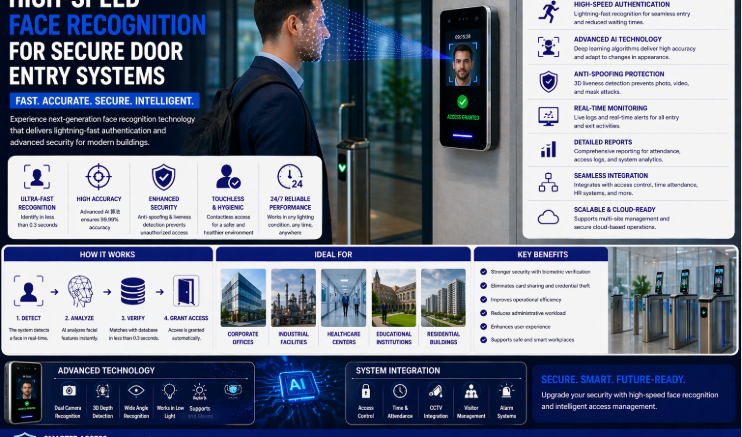
Face recognition access control systems capture and analyse facial features of authorised personnel. When an employee approaches an access point, the system compares their facial data against a database of registered users. If the match is confirmed, access is granted automatically. The entire process typically takes just a few seconds.
The technology works effectively even in varying lighting conditions, making it reliable for factory environments where lighting may not always be optimal. Modern systems also incorporate anti-spoofing measures to prevent unauthorised access through photographs or masks.
Key Features of Industrial Face Recognition Systems
Modern face recognition access control systems for industrial use typically include:
- Real-time identification: Instant facial recognition without requiring employees to present cards or enter codes
- High accuracy: Advanced algorithms minimise false rejections and false acceptances
- Temperature detection (where applicable): Some systems integrate thermal imaging for fever screening
- Integration capabilities: Compatibility with existing security infrastructure and time attendance systems
- Detailed audit logs: Complete records of all access events for compliance and investigation purposes
- Multi-factor authentication options: Combination of facial recognition with PIN or card for enhanced security
- Weather-resistant hardware: Durable equipment suitable for demanding factory environments
Cost Considerations for Industrial Factories in Singapore
Understanding Total Cost of Ownership
When evaluating face recognition access control systems, it is important to consider the complete cost structure, not just the initial hardware purchase price. Total cost of ownership typically includes:
- Hardware costs (facial recognition terminals, cameras, processing units)
- Software licensing fees
- Installation and integration services
- Staff training
- Maintenance and support contracts
- System upgrades and updates
The cost will vary depending on the size of your facility, number of access points required, complexity of your security requirements, and the level of system integration needed. A small factory with one or two access points will have a significantly lower investment than a large manufacturing complex with multiple entry and exit points across several buildings.
Return on Investment
Whilst the upfront investment is meaningful, many industrial factories in Singapore find that face recognition systems deliver strong returns through:
- Reduced administrative time managing access credentials
- Lower costs associated with replacing lost cards or forgotten PINs
- Improved security reducing theft and unauthorised access incidents
- Better compliance with safety and regulatory requirements
- Faster employee onboarding and offboarding processes
- Enhanced productivity by reducing time spent at access checkpoints
Features That Matter for Industrial Environments
Durability and Reliability
Industrial factories operate in demanding conditions. Equipment may be exposed to dust, moisture, temperature fluctuations, and physical impacts. Effective face recognition systems must be designed to withstand these environments. Look for systems with:
- Industrial-grade hardware with appropriate IP ratings for dust and water resistance
- Temperature-tolerant components suitable for Singapore’s tropical climate
- Robust mounting solutions that prevent tampering or accidental damage
Integration and Scalability
A well-designed access control system must integrate smoothly with your existing infrastructure. This includes:
- Connection to time attendance systems
- Integration with security monitoring systems
- Compatibility with existing door locks and electronic barriers
- Ability to scale as your facility grows
Scalability is particularly important for growing factories that may add new facilities or expand operations over time.
Compliance and Audit Capabilities
Singapore businesses must comply with various employment and security regulations. A robust face recognition system should provide:
- Comprehensive audit trails showing exactly who accessed which areas and when
- Ability to generate reports for compliance verification
- Secure storage of access data with appropriate backup and recovery procedures
- Clear role-based access control so employees can only enter authorised areas
Common Challenges and Practical Solutions
Data Privacy Concerns
Collecting and storing facial data raises legitimate privacy considerations. When implementing a face recognition system, ensure that:
- Your approach complies with Singapore’s Personal Data Protection Act (PDPA) requirements
- Employee consent is obtained before implementing facial recognition
- Data retention policies are clearly defined
- Facial data is stored securely with appropriate encryption
It is advisable to consult with your legal team regarding PDPA compliance when implementing any facial recognition system.
Accuracy in Challenging Conditions
Industrial environments may present challenges such as:
- Bright or dim lighting conditions
- Employees wearing safety equipment (masks, helmets, goggles)
- High foot traffic during shift changes
- Outdoor access points exposed to weather
Modern systems are increasingly sophisticated at handling these scenarios. Systems incorporating infrared technology and advanced algorithms can recognise faces even when partial facial features are obscured or when lighting is sub-optimal.
Employee Adoption
Successful implementation requires employee buy-in. Address adoption challenges by:
- Communicating clearly about why the system is being introduced
- Providing adequate training before the system goes live
- Establishing a grace period for staff to become familiar with the technology
- Demonstrating how the system simplifies daily processes
- Creating clear procedures for issues such as facial recognition failures
How Smart Touch Technology Singapore Can Help
Smart Touch Technology Singapore provides face and door access control solutions specifically designed for industrial and commercial environments. The Face & Door access system is engineered to meet the demanding requirements of Singapore factories and manufacturing facilities.
By partnering with Smart Touch Technology, your factory benefits from:
- Purpose-built systems designed for industrial durability and reliability
- Professional installation and integration with your existing infrastructure
- Local support and maintenance services based in Singapore
- Comprehensive training for your security and administrative staff
- Ongoing system updates and feature enhancements
Smart Touch Technology understands the specific security and operational challenges faced by Singapore’s industrial sector and can tailor solutions to your facility’s unique requirements.
Implementation Best Practices
When implementing face recognition access control in your factory, consider the following best practices:
- Plan comprehensively: Map all access points and determine which areas require restricted access
- Start with pilot deployment: Test the system at one or two access points before full rollout
- Establish clear policies: Define access levels for different employee groups and visitor management procedures
- Train thoroughly: Ensure all staff understand how to use the system and what to do if recognition fails
- Monitor and adjust: Regularly review access logs and system performance, making adjustments as needed
- Maintain accurate records: Keep your employee database updated to reflect current staff and their access requirements
Conclusion
Face recognition access control technology offers Singapore’s industrial factories a secure, efficient, and modern approach to managing facility access. By moving beyond traditional key cards and PIN codes, factories can improve security, reduce administrative burden, and enhance overall operational efficiency.
The investment in face recognition access control is justified by the tangible benefits: improved security, faster employee processing, comprehensive audit capabilities, and reduced costs associated with credential management. However, successful implementation requires careful planning, appropriate technology selection, and attention to privacy and compliance considerations.
Want to know more about this product? Click here to explore Smart Touch Technology Singapore’s Face & Door access control solutions and discover how they can enhance security at your industrial facility.
Smart Touch technology pte ltd , www.smartouch.com.sg +65-63964767, sales@smartouch.com.sg , www.smartouch.com.my +607-3889903 sales@smartouch.com.my