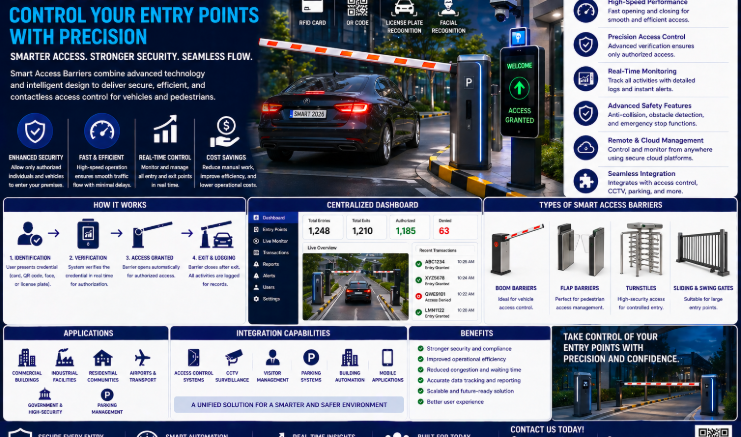
Introduction: Precision Control for Modern Access Management
In 2026, managing entry and exit points is no longer just about opening and closing gates—it is about precision, automation, and intelligent security. With increasing demands for safety, efficiency, and seamless operations, businesses require smarter solutions to control access across their facilities.
Smart access barriers have emerged as a powerful technology that enables organizations to manage vehicle and pedestrian entry points with accuracy, speed, and reliability.
Our focus is to explore how smart access barriers are transforming access control and why they are essential for modern infrastructure.
What Are Smart Access Barriers?
Smart access barriers are automated systems designed to regulate and control entry and exit points using advanced technologies such as:
- RFID and access cards
- License Plate Recognition (LPR)
- QR code and mobile access
- Biometric authentication
- Remote and cloud-based control systems
These barriers include solutions such as:
- Boom gates
- Flap barriers
- Swing gates
- Turnstiles
They provide controlled, secure, and efficient access for both vehicles and pedestrians.
Why Smart Access Barriers Are Essential
Increasing Security Needs
Organizations must protect assets, employees, and facilities from unauthorized access.
High Traffic Environments
Busy locations require fast and efficient access control to avoid congestion.
Demand for Automation
Manual gate control is inefficient and prone to human error.
Need for Real-Time Monitoring
Businesses require instant visibility and control over access activities.
Key Features of Smart Access Barriers
High-Speed Operation
Smart barriers open and close rapidly, ensuring smooth traffic flow without delays.
Precision Access Control
Only authorized users can gain entry through:
- RFID cards
- Facial recognition
- License plate detection
Real-Time Monitoring
Track all entry and exit activities with:
- Time stamps
- User identification
- Vehicle data
Advanced Safety Mechanisms
Equipped with:
- Anti-collision sensors
- Obstacle detection
- Emergency stop functions
These features ensure safe operation at all times.
Remote and Cloud-Based Management
Control and monitor barriers from anywhere using centralized dashboards.
Seamless Integration
Integrates with:
- Access control systems
- CCTV surveillance
- Visitor management systems
- Parking management platforms
Benefits of Smart Access Barriers
Enhanced Security
Prevent unauthorized access and ensure only verified individuals or vehicles can enter.
Improved Traffic Flow
Reduce congestion and waiting times with fast and automated operations.
Operational Efficiency
Minimize manual intervention and streamline access control processes.
Cost Savings
Reduce reliance on security personnel and manual monitoring.
Accurate Data Tracking
Maintain detailed logs for audits, reporting, and analysis.
Types of Smart Access Barriers
Boom Barriers
Ideal for vehicle entry points such as parking lots, commercial buildings, and industrial facilities.
Flap Barriers
Designed for pedestrian access in offices, transport hubs, and secure facilities.
Turnstiles
Provide controlled entry for high-security areas and high-traffic environments.
Sliding and Swing Gates
Suitable for larger entry points requiring additional security.
Applications Across Industries
Commercial Buildings
Control employee and visitor access efficiently.
Industrial Facilities
Secure entry points for workers, vehicles, and equipment.
Residential Communities
Enhance safety and manage vehicle access.
Airports and Transportation Hubs
Handle high volumes of traffic with precision and speed.
Government and High-Security Sites
Implement strict access control with detailed monitoring.
Integration with Smart Systems
In 2026, smart access barriers are part of a connected ecosystem. They integrate with:
- Building automation systems (BAS)
- IoT devices
- Mobile applications
- Cloud-based platforms
This creates a unified and intelligent access management system.
Future Trends in Smart Access Barriers
AI-Powered Access Control
Artificial intelligence will optimize traffic flow and enhance security decisions.
Contactless Access
Facial recognition and mobile credentials will dominate future systems.
Predictive Maintenance
IoT sensors will detect issues before failures occur.
Smart City Integration
Barriers will become part of urban infrastructure for traffic and security management.
Why Choose Our Smart Access Barrier Solutions
Our solutions are designed to deliver precision, reliability, and efficiency with:
- High-speed and durable barrier systems
- Advanced access control integration
- Real-time monitoring and analytics
- Scalable and customizable solutions
- Professional installation and support
We are committed to helping businesses achieve smarter and more secure access control.
Conclusion: Precision Access for a Smarter Future
Smart access barriers are redefining how organizations manage entry points in 2026. By combining automation, intelligence, and precision, they provide a powerful solution for modern access control.
Businesses that adopt smart barrier systems will benefit from enhanced security, improved efficiency, and seamless operations.
Upgrade your access control today and take full control of your entry points with precision.
For more information for the product, please click here: https://smartouch.com.sg/barrier/
Smart Touch technology pte ltd , www.smartouch.com.sg +65-63964767, sales@smartouch.com.sg , www.smartouch.com.my +607-3889903 sales@smartouch.com.my