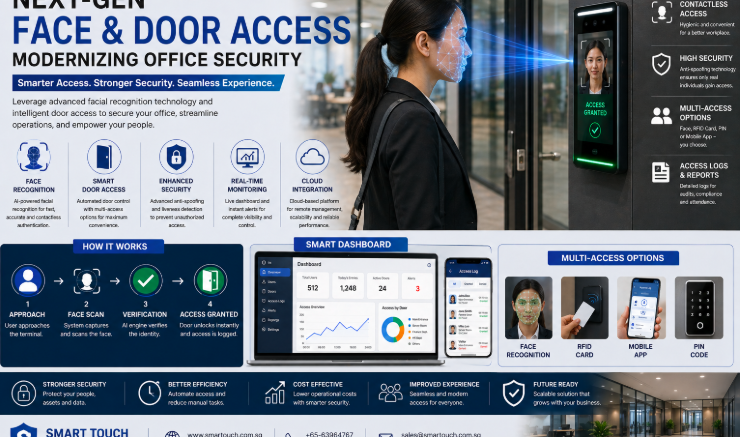
Smart buildings in Singapore are moving beyond simple card readers and PIN pads to secure their lobbies and restricted zones. A Facial Recognition Swing Barrier combines the physical control of a swing gate with the identity assurance of biometric verification, giving building managers a security upgrade that is both fast and reliable. This article explains what makes swing barriers with facial recognition a strong fit for smart buildings in 2026, and what to look for when selecting a system.
What Is a Facial Recognition Swing Barrier?
A swing barrier is a type of access gate with pivoting arms or panels that open to allow entry, commonly used in office lobbies, residential buildings, and commercial premises. When paired with facial recognition, the barrier only opens once the system has verified the identity of the person approaching, replacing the need for a card tap or manual security check.
Why Smart Buildings Are Adopting Facial Recognition Swing Barriers in 2026
As building security expectations rise and tenants demand smoother, more modern entry experiences, facial recognition swing barriers offer a way to combine strong security with a frictionless user experience. Unlike flap barriers or full-height turnstiles, swing barriers are also well suited to buildings with accessibility requirements, such as spaces needing wheelchair access.
Common Limitations of Traditional Swing Barriers
- Card-based verification does not confirm who is actually passing through.
- Manual security checks slow down entry during peak hours.
- Limited audit trail when access relies solely on shared credentials.
- Difficulty managing visitor access without a dedicated process.
- Inconsistent enforcement when security staff are not present at all times.
Key Features of a Facial Recognition Swing Barrier
| Feature | Description |
|---|---|
| Fast facial verification | Confirms identity in under a second before releasing the barrier |
| Wide accessibility lane option | Configurable barrier width to accommodate wheelchairs and trolleys |
| Anti-tailgating sensors | Detects and alerts on attempts by unauthorised individuals to follow closely behind |
| Multi-modal verification | Supports card or QR code as backup alongside facial recognition |
| Visitor management integration | Grants temporary access to registered visitors |
| Centralised access logs | Records every entry event for security review and compliance |
Key Benefits for Smart Building Security
- Stronger identity verification — access is tied to the individual, not just a card or code.
- Improved tenant experience — fast, contactless entry reduces queues at busy lobby entrances.
- Accessible design — swing barriers can accommodate wheelchairs and other mobility needs more easily than full turnstiles.
- Better security oversight — anti-tailgating detection and access logs strengthen overall building security.
- Simplified visitor management — temporary access can be granted and revoked without issuing physical cards.
How a Facial Recognition Swing Barrier Works
1. Enrolment
Tenants, employees, or residents have their facial data captured once during registration.
2. Approach Detection
As a person approaches, the camera detects and captures their face.
3. Identity Verification
The system matches the face against the enrolled database in real time.
4. Barrier Release
Upon successful match, the swing panels open to allow entry.
5. Tailgating Detection
Sensors monitor for unauthorised individuals attempting to follow closely behind a verified user.
6. Access Logging
Every entry event is logged with identity, time, and location for security records.
Full-Height Turnstile vs Facial Recognition Swing Barrier
| Factor | Full-Height Turnstile | Facial Recognition Swing Barrier |
|---|---|---|
| Accessibility | Difficult for wheelchairs or trolleys | Configurable wide lane for easy access |
| Entry speed | Slower due to physical rotation | Fast — swing panels open instantly |
| Aesthetic fit | Bulky, industrial appearance | Sleeker design suited to modern lobbies |
| Identity verification | Often card-based only | Biometric verification standard |
| Tailgating risk | Lower due to physical barrier height | Managed through sensor-based detection |
This comparison shows why many modern smart buildings prefer facial recognition swing barriers over bulkier turnstile alternatives, particularly where accessibility and aesthetics matter.
Best Practices for Choosing a Swing Barrier System
Prioritise Accessibility Requirements
Ensure at least one lane is configured wide enough to accommodate wheelchairs, trolleys, and other mobility needs.
Confirm Anti-Tailgating Capability
Ask vendors how their system detects and responds to tailgating attempts.
Plan for Visitor Access
Choose a system that integrates with visitor management for temporary, revocable access.
Evaluate Aesthetic Fit
Select a barrier design that complements the building’s lobby aesthetics, especially for premium commercial spaces.
Key Takeaways
- Facial recognition swing barriers combine strong identity verification with fast, accessible entry.
- They are well suited to smart buildings prioritising both security and tenant experience.
- Anti-tailgating detection and access logging strengthen overall building security oversight.
- Accessibility configuration and visitor management integration are key selection factors.
- Swing barriers often offer a better aesthetic and accessibility fit than full-height turnstiles.
Frequently Asked Questions
1. Can facial recognition swing barriers accommodate wheelchair access?
Yes. Most systems allow at least one lane to be configured wider to accommodate wheelchairs, trolleys, and other mobility needs.
2. How does the system detect tailgating attempts?
Sensors monitor the entry lane for unauthorised individuals attempting to pass through immediately after a verified user.
3. Can visitors be granted temporary access through the barrier?
Yes. Many systems integrate with visitor management platforms to issue temporary, revocable access credentials.
4. Is facial data collected from tenants stored securely?
Reputable vendors store biometric data with appropriate security measures, and building managers should confirm data handling practices before rollout.
5. How fast is the verification process compared to a card tap?
Facial recognition verification typically takes under a second, often faster than a card tap and PIN entry combined.
6. Can the system be integrated with existing building management software?
Yes. Many facial recognition swing barrier systems can integrate with existing building management and security infrastructure.
Conclusion
As smart buildings across Singapore look to modernise their entry security ahead of 2026, a Facial Recognition Swing Barrier offers a strong combination of speed, accessibility, and identity assurance that traditional card-based systems and bulky turnstiles cannot match. By verifying identity directly and supporting features like anti-tailgating detection and visitor management integration, building managers can deliver a security upgrade that also improves the everyday experience for tenants and visitors alike.
Want to know more about this product? Click here: https://smartouch.com.sg/face-and-door-access/
Smart Touch technology pte ltd , www.smartouch.com.sg +65-63964767, sales@smartouch.com.sg , www.smartouch.com.my +607-3889903 sales@smartouch.com.my