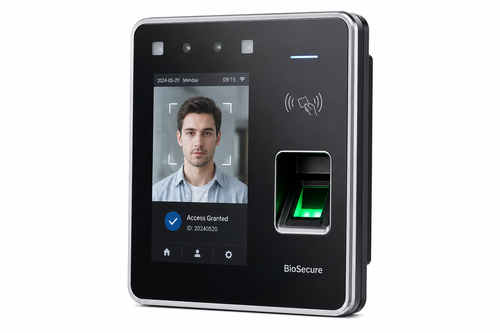
Workplace security has evolved far beyond traditional locks, keys, and access cards. As businesses across Singapore embrace digital transformation, modern biometric security access solutions have become the preferred choice for protecting offices, factories, warehouses, hospitals, educational institutions, and commercial buildings.
Unlike conventional access methods that rely on cards or PINs, biometric security verifies the actual identity of each individual using unique physical characteristics such as facial recognition or fingerprint authentication. This provides stronger security, faster entry, and better control over workplace access while simplifying administration.
Smart Touch Technology delivers a complete Biometric Security Access Solution Singapore that integrates AI Facial Recognition, Fingerprint Access Control, Smart Swing Barriers, Door Access Control Systems, Visitor Management System (VMS), SmartHR, SmartGoGo, Employee Time Attendance, and cloud-based access management into one intelligent workplace security platform.
Why Traditional Access Control Is No Longer Enough
Conventional access control methods such as keys, access cards, RFID tags, and PIN codes all share one major weakness—they verify the credential rather than the person using it.
Common security challenges include:
- Lost or stolen access cards
- Shared employee cards
- Forgotten PIN codes
- Card cloning
- Manual key management
- Delayed employee offboarding
- Limited access visibility
- Higher administrative workload
As organisations expand across multiple offices or facilities, managing these traditional systems becomes increasingly inefficient and vulnerable to security risks.
What Is a Modern Biometric Security Access Solution?
A biometric security access solution uses advanced biometric technology to verify an individual’s identity before granting access to secured areas.
Instead of relying solely on physical credentials, the system authenticates users through unique biometric characteristics such as facial recognition or fingerprint verification.
Once verified, authorised personnel can enter automatically while every access event is securely recorded for monitoring, reporting, and compliance purposes.
Core Components of a Modern Biometric Security Solution
AI Facial Recognition
Facial Recognition enables fast, secure, and contactless workplace access.
Features include:
- Contactless authentication
- AI-powered facial recognition
- High recognition accuracy
- Anti-spoofing protection
- Real-time identity verification
- Fast employee access
Employees can enter without tapping a card or entering a PIN, reducing queues and improving convenience.
Fingerprint Verification
Fingerprint authentication provides an additional layer of protection for sensitive or restricted areas.
Ideal applications include:
- Server rooms
- Executive offices
- Research laboratories
- Financial departments
- Data centres
- High-security facilities
Fingerprint verification ensures only authorised personnel can access critical business areas.
Door Access Control
Smart Touch Door Access Control centralises workplace access management.
Capabilities include:
- Employee access permissions
- Department-based access
- Time-based access schedules
- Multi-door administration
- Restricted area management
- Instant permission updates
Administrators can manage access across multiple buildings from one platform.
Smart Swing Barrier Integration
The biometric platform integrates with Smart Touch Swing Barrier Systems.
Supported entrance solutions include:
- Swing Barriers
- Speed Gates
- Flap Barriers
- Glass Turnstiles
- Full Height Turnstiles
- Pedestrian Access Gates
These systems provide secure yet efficient pedestrian flow in high-traffic environments.
Centralised Cloud Access Management
A secure cloud dashboard allows administrators to manage every access point from one location.
Dashboard features include:
- Multi-site administration
- User management
- Real-time access monitoring
- Permission management
- Audit reports
- Security analytics
- Remote administration
Cloud management simplifies workplace security for organisations with multiple offices or branches.
Integrated Audit Trails
Every access event is automatically recorded.
Digital audit records include:
- Entry time
- Exit time
- User identity
- Access location
- Authentication method
- Access status
- Historical activity logs
Digital records support internal investigations, compliance reporting, and security monitoring.
Benefits of Biometric Security for Workplace Management
Organisations implementing biometric security solutions benefit from:
- Stronger workplace security
- Contactless employee access
- Faster building entry
- Reduced dependency on access cards
- Lower administrative workload
- Centralised access management
- Real-time monitoring
- Complete audit trails
- Multi-site management
- Scalable deployment
Traditional Access Control vs Modern Biometric Security
| Feature | Traditional Card / PIN Access | Smart Touch Biometric Access |
|---|---|---|
| Identity Verification | Verifies card or PIN | Verifies the individual |
| Lost Credentials | Cards can be lost or shared | No physical credential required |
| Security | Moderate | High |
| Entry Speed | Requires tap or PIN | Fast contactless verification |
| Administration | Manual card management | Centralised cloud management |
| Audit Trail | Card activity only | Verified identity records |
| Multi-site Control | Limited | Centralised platform |
| Integration | Basic | SmartHR, VMS & Door Access Control |
SmartHR & Workforce Integration
Smart Touch biometric solutions integrate seamlessly with SmartHR.
Integration includes:
- Employee onboarding
- Staff database synchronisation
- Department management
- Employee status updates
- Workforce administration
- Employee Time Attendance
Access permissions can be updated automatically when employees join, transfer departments, or leave the organisation.
Visitor Management Integration
The Smart Touch Visitor Management System (VMS) works alongside biometric access control.
Features include:
- Visitor pre-registration
- QR code check-in
- Temporary visitor access
- Host notifications
- Digital visitor records
- Visitor activity logs
Visitors and employees can be managed from one integrated security platform.
Suitable for Various Industries
Smart Touch Biometric Security Access Solutions are suitable for:
- Corporate Offices
- Commercial Buildings
- Manufacturing Facilities
- Warehouses
- Logistics Centres
- Hospitals
- Educational Institutions
- Hotels
- Government Buildings
- Residential Developments
- Construction Sites
- Data Centres
Best Practices for Implementing Biometric Security
To maximise security and operational efficiency:
- Conduct a security assessment to identify different access zones.
- Apply role-based access permissions according to job responsibilities.
- Enrol employees during onboarding for a smooth deployment.
- Integrate biometric access with HR and Visitor Management systems.
- Configure backup authentication methods for exceptional situations.
- Pair biometric access with CCTV for enhanced security monitoring.
- Review access reports regularly to identify unusual activity.
- Remove or update employee access promptly when roles or employment status change.
A well-planned implementation helps strengthen workplace security while maintaining a seamless user experience.
Supporting Responsible Biometric Security
Modern biometric access systems help organisations improve workplace security through encrypted biometric authentication, configurable access permissions, secure communication, digital audit trails, and centralised administration.
Smart Touch provides administrator controls, AI facial recognition, fingerprint authentication, cloud-based management, and integrated reporting to support responsible workplace security. Organisations remain responsible for establishing access policies, managing user permissions, and ensuring compliance with applicable legal and regulatory requirements, including Singapore’s Personal Data Protection Act (PDPA).
Why Choose Smart Touch Technology Singapore?
Smart Touch Technology is a trusted provider of intelligent workplace security and workforce management solutions in Singapore.
Our integrated platform includes:
- AI Facial Recognition
- Fingerprint Access Control
- Door Access Control System
- Smart Swing Barrier
- Full Height Turnstile
- Visitor Management System (VMS)
- SmartHR
- SmartGoGo
- Employee Time Attendance
- CCTV Integration
From consultation and site assessment to hardware installation, biometric enrolment, software configuration, administrator training, preventive maintenance, and after-sales technical support, Smart Touch delivers scalable biometric security solutions tailored to your organisation.
Whether you operate a corporate office, manufacturing plant, warehouse, hospital, commercial building, educational institution, residential development, or data centre, Smart Touch provides reliable technology that strengthens workplace security while simplifying day-to-day access management.
Frequently Asked Questions
What makes biometric access more secure than card-based systems?
Biometric access verifies the identity of the actual individual rather than relying on a physical credential that can be lost, shared, or copied.
Can biometric access be applied only to restricted areas?
Yes. Administrators can create role-based access permissions so that biometric verification is required only for designated high-security zones while standard areas use different authentication methods if required.
Is biometric data stored securely?
Yes. Smart Touch stores encrypted biometric templates rather than raw biometric images and provides administrator-controlled access to biometric information to help organisations manage data responsibly.
Can biometric access integrate with HR systems?
Yes. Smart Touch integrates with SmartHR to automatically update employee information and access permissions when staff join, transfer, or leave the organisation.
Is biometric access suitable for multi-site organisations?
Yes. The cloud-based platform allows organisations to manage employee access, permissions, and activity across multiple offices, buildings, or facilities from one centralised dashboard.
Upgrade Your Workplace Security with Smart Touch
Traditional access cards and PIN-based systems are no longer enough to meet the security demands of modern workplaces. Smart Touch Biometric Security Access Solutions combine AI facial recognition, fingerprint authentication, Door Access Control, Smart Swing Barriers, Visitor Management, SmartHR integration, and cloud-based administration into one intelligent platform.
Whether you manage a corporate headquarters, manufacturing facility, logistics centre, warehouse, hospital, educational institution, commercial building, or multi-site enterprise, Smart Touch Technology provides scalable solutions that improve workplace security while delivering a seamless access experience.
Learn more about our Biometric Access Control Solutions:
Smart Touch Technology Pte Ltd
www.smartouch.com.sg | +65-63964767 | sales@smartouch.com.sg
www.smartouch.com.my | +607-3889903 | sales@smartouch.com.my