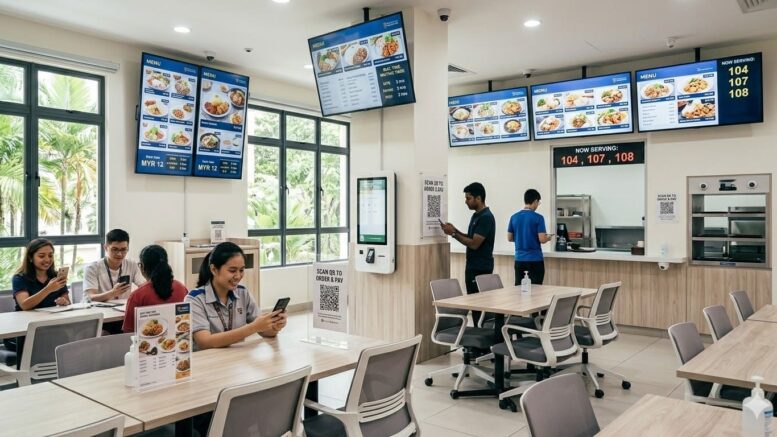
Long queues, cash handling, and manual meal subsidy tracking are common pain points in corporate and factory canteens across Singapore. A canteen management system with face recognition solves all three at once — employees are identified and billed automatically at the point of purchase, with zero cards, cash, or queues for verification.
This article explains how face recognition canteen systems work, the operational benefits for HR and finance teams, and what businesses should evaluate before adopting one.
What Is a Face Recognition Canteen Management System?
A face recognition canteen system replaces manual cashier transactions or card-tap payments with biometric identification. When an employee steps up to the point-of-sale terminal, the system recognises their face, matches it to their employee profile, applies any applicable meal subsidy or allowance, and deducts the cost automatically — all within seconds.
This is particularly useful in large factories, dormitories, and corporate campuses where hundreds or thousands of employees eat within a narrow lunch window, since even a small delay per transaction compounds quickly across a high-volume service period.
Beyond speed, the system creates a clean, itemised digital record of every meal purchase, which HR and finance teams can use to reconcile subsidy budgets accurately without manually cross-checking receipts or card logs at month-end.
Why Face Recognition Beats Cards and Cash
Traditional canteen payment methods carry hidden costs: lost or shared access cards, cash handling and reconciliation errors, and long queues during peak hours. Face recognition removes all three — there’s nothing to forget, lose, or share, and transactions complete in under two seconds per person.
Key Benefits for Employers and Canteen Operators
| Benefit | Impact |
|---|---|
| Faster throughput | Shorter queues during peak lunch periods |
| Accurate subsidy tracking | Automatic application of meal allowances per employee tier |
| Reduced fraud | Eliminates card-sharing and buddy-punching for meal benefits |
| Cashless operations | Reduces cash-handling risk and reconciliation workload |
| Centralised reporting | Finance teams get real-time spend and headcount data per meal period |
How the System Works: A Step-by-Step Guide
- Employee enrolment — Staff photos are registered once during onboarding, linked to their employee ID and any applicable subsidy tier.
- Menu and pricing setup — Canteen operators configure item pricing and subsidy rules in the system.
- Point-of-sale scan — At the counter, the camera identifies the employee as they select their meal.
- Automatic deduction — The system applies the subsidy and deducts the balance from payroll, a prepaid account, or a linked wallet.
- Reporting and reconciliation — HR and finance access daily, weekly, or monthly reports on meal spend, subsidy usage, and attendance patterns.
Best Practices for Implementation
Start enrolment early and communicate the process clearly to staff, since face recognition depends on accurate initial registration. Set subsidy tiers and pricing rules before go-live to avoid billing disputes in the first week. Keep a manual fallback (such as a supervisor override) available for the rare case of a recognition failure. Review usage reports monthly to catch anomalies, such as unusually high subsidy claims from a single account. It’s also worth piloting the system in a single canteen or shift before a full rollout, since real-world queue patterns and peak-hour loads often reveal configuration adjustments — such as terminal placement or menu item grouping — that aren’t obvious during initial setup.
Comparing Payment Methods
- Cash: Slowest, highest handling risk, no automatic reporting.
- Card/QR tap: Faster than cash but vulnerable to sharing and loss.
- Face recognition: Fastest, most secure, fully automated reporting — no physical credential required.
Choosing the Right Canteen Management System
Businesses should look for a system that integrates with existing HR and payroll platforms so subsidy deductions flow through without manual reconciliation. Recognition speed and accuracy under real-world conditions — including masks, changing hairstyles, and varying lighting — should be tested before committing. It’s also worth confirming how facial data is stored and secured, given its sensitivity under Singapore’s PDPA requirements.
Cost and ROI Considerations
Implementation cost depends on the number of point-of-sale terminals, whether existing canteen infrastructure needs retrofitting, and the software licensing model. Most organisations recoup the investment through reduced cash-handling labour, fewer disputes over subsidy allocation, and shorter queue times that reduce lost productivity during lunch breaks. For large factories or campuses with thousands of daily transactions, the efficiency gains compound quickly, often making the payback period shorter than for smaller offices with lighter canteen traffic.
Real-World Application in Singapore Workplaces
Manufacturing plants, logistics hubs, and large dormitory-linked canteens in Singapore have been early adopters of face recognition payment, largely because these environments face the sharpest queueing and fraud challenges during concentrated meal windows. Facilities managers commonly report that switching from cash or cards to facial recognition significantly shortens peak-hour queues while giving HR accurate, real-time data on subsidy usage across different worker categories — data that was previously reconciled manually at month-end.
Key Takeaways
- Face recognition canteen systems remove queues, cash handling, and card-sharing fraud.
- Subsidies and pricing rules are applied automatically at the point of purchase.
- Integration with payroll and HR systems reduces administrative reconciliation work.
- Data security and PDPA compliance should be confirmed with any vendor before rollout.
Conclusion
A face recognition canteen management system turns one of the most operationally messy parts of running a large workplace — feeding hundreds or thousands of employees efficiently — into a fast, automated, and fully accountable process. For Singapore businesses managing factories, dormitories, or large office campuses, the combination of shorter queues, accurate subsidy tracking, and reduced fraud makes a strong case for moving away from cash and cards.
Frequently Asked Questions
1. How fast is a face recognition canteen transaction? Typically under two seconds per employee, significantly faster than cash or card transactions.
2. What happens if the system fails to recognise an employee? Most systems support a manual override or backup ID entry so service isn’t interrupted.
3. Is facial data stored securely? Reputable systems store facial data in encrypted form and restrict access to authorised administrators only, in line with PDPA requirements.
4. Can the system apply different subsidy rates for different employee groups? Yes, subsidy tiers can typically be configured by department, seniority, or shift pattern.
5. Does the canteen system integrate with payroll? Most enterprise-grade systems support integration with common payroll and HR platforms for automatic deduction and reporting.
6. Can the system support multiple canteens or outlets across one company? Yes, enterprise deployments typically support centralised management across multiple canteen locations, with consolidated reporting for finance and HR teams.
Click here for more product information: https://smartouch.com.sg/canteen-system/
Smart Touch technology pte ltd , www.smartouch.com.sg +65-63964767, sales@smartouch.com.sg , www.smartouch.com.my +607-3889903 sales@smartouch.com.my