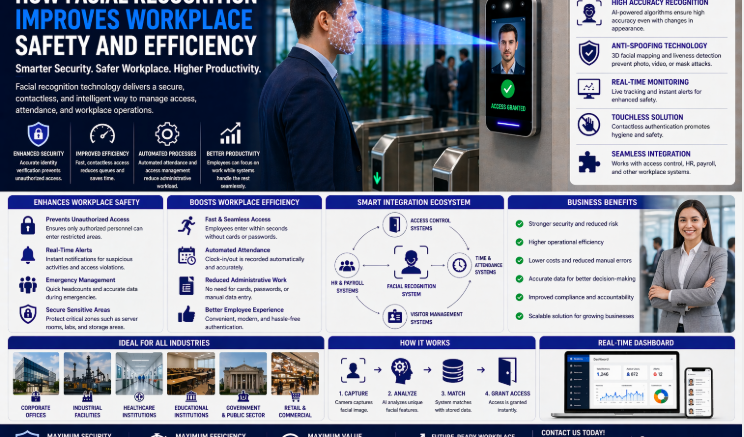
Reception desks and lobby security staff can only do so much to control who enters an office or facility, especially during busy periods. A turnstile with face recognition automates that first line of physical access control, verifying identity and granting entry in a single, fast motion — without requiring cards, fobs, or manual checks at every entry.
This article explains how face recognition turnstiles work, the practical benefits for Singapore workplaces, and what to consider when choosing one.
What Is a Face Recognition Turnstile?
A face recognition turnstile combines a physical barrier — typically a swing, flap, or tripod-style gate — with an integrated facial recognition camera. As an authorised individual approaches, the system verifies their identity against an enrolled database and releases the barrier automatically, all within roughly one second.
Why Combine a Turnstile with Face Recognition
Turnstiles alone control physical movement but still typically require a card, fob, or PIN to trigger release, all of which can be shared, lost, or forgotten. Adding face recognition removes the credential entirely — identity itself becomes the access method, which is both more secure and more convenient for employees moving through the lobby each day. Over hundreds of entries per week, the cumulative time saved and friction removed adds up to a noticeably smoother start and end to the workday for staff.
Key Benefits for Singapore Workplaces
| Benefit | Impact |
|---|---|
| Contactless entry | No cards, fobs, or PINs needed to pass through |
| Stronger security | Facial identity cannot be shared or duplicated like a card |
| Faster throughput | Sub-second verification reduces lobby congestion during peak hours |
| Audit trail | Every entry is logged with identity and timestamp |
| Professional impression | Modern, frictionless entry experience for staff and visitors |
How a Face Recognition Turnstile Works: A Step-by-Step Guide
- Enrolment — Employees register their facial profile once, linked to their access permissions.
- Approach detection — As a person approaches the turnstile, the camera captures their face.
- Real-time matching — The system matches the captured face against the enrolled database within a fraction of a second.
- Barrier release — On successful verification, the turnstile arm or flap releases to allow entry.
- Access logging — Every successful and failed access attempt is logged for security and reporting purposes.
Best Practices for Deployment
Position cameras at the correct height and angle for consistent recognition across different heights and walking speeds. Enrol employees with clear, well-lit photos to maximise recognition accuracy from day one. Set a sensible fallback process — such as a security guard override — for edge cases like new hires not yet enrolled or visitors requiring temporary access. Review access logs periodically to identify unusual entry patterns. Plan for a brief transition period where both the old and new access methods work in parallel, giving staff time to adjust without risking being locked out during the changeover.
Comparing Turnstile Access Methods
- Card/fob turnstiles: Functional but vulnerable to sharing, loss, and cloning.
- PIN turnstiles: Simple but easily observed or shared.
- Face recognition turnstiles: Fast, non-transferable, and requires nothing to carry or remember.
Choosing the Right Turnstile System
Businesses should evaluate recognition speed and accuracy under real foot-traffic conditions, the physical durability of the turnstile mechanism for high daily usage, and how well the system integrates with existing access control or visitor management platforms. Aesthetic fit with the lobby environment is also worth considering, since the turnstile is often a visible part of the workplace’s first impression.
Cost and ROI Considerations
Pricing depends on the turnstile mechanism selected, the number of lanes required, and whether existing access control infrastructure can be reused. The return on investment typically comes through reduced reception and security staffing needs at the entry point, fewer lost or reissued access cards, and a stronger, more auditable security posture that reduces the likelihood of costly unauthorised access incidents.
Real-World Application in Singapore Offices
Corporate offices, business parks, and mixed-use developments in Singapore have increasingly replaced card-based turnstiles with face recognition models as part of broader workplace modernisation projects. Facilities teams often note that beyond the security improvement, employees appreciate not needing to carry or tap a card every time they enter, which becomes a small but consistently noticed convenience across hundreds of daily entries.
Comparing Turnstile Types
- Tripod turnstiles: Compact and cost-effective, suited to lower-security office lobbies.
- Flap barrier turnstiles: Sleeker design with faster throughput, common in corporate and commercial settings.
- Full-height turnstiles: Maximum physical security, typically used for higher-risk or outdoor perimeter applications.
Key Takeaways
- Face recognition turnstiles combine physical access control with contactless identity verification.
- Sub-second recognition supports smooth throughput even during peak entry times.
- Every entry is logged, supporting both security and operational reporting.
- Deployment should include a fallback process for enrolment gaps or edge cases.
Conclusion
A turnstile with face recognition brings together physical security and everyday convenience, giving Singapore workplaces a fast, contactless, and highly auditable way to control lobby access. For businesses looking to modernise their entry experience while tightening security, it’s a practical upgrade from card- or PIN-based systems.
Frequently Asked Questions
1. How fast is face recognition verification at a turnstile? Typically under one second per person under normal conditions.
2. What happens if an employee isn’t recognised? Most systems support a fallback method, such as manual verification by security staff, to avoid entry delays.
3. Can visitors use a face recognition turnstile? Yes, when integrated with a visitor management system, temporary facial profiles or alternative verification can be issued for visitors.
4. Is facial recognition data stored securely? Reputable systems encrypt and restrict access to enrolled facial data, in line with PDPA requirements.
5. Can the turnstile integrate with existing access control systems? Most face recognition turnstiles are designed to integrate with common access control and visitor management platforms.
6. How many people can a face recognition turnstile process per minute? Throughput varies by model, but sub-second verification typically allows turnstiles to comfortably handle high-volume peak periods, such as morning entry rushes, without significant queuing.
For more information about the product, please click here: https://smartouch.com.sg/barrier/
Smart Touch technology pte ltd , www.smartouch.com.sg +65-63964767, sales@smartouch.com.sg , www.smartouch.com.my +607-3889903 sales@smartouch.com.my