Managing employee attendance across multiple locations is one of the most common operational challenges for Singapore businesses. Whether you operate retail outlets, service centres, construction sites, or office branches across the island, keeping accurate attendance records becomes exponentially more complex as your business grows.
Manual attendance systems—sign-in sheets, punch cards, or basic spreadsheets—create numerous opportunities for errors, time theft, and administrative headaches. These problems multiply significantly when your team is spread across different sites, time zones become irrelevant, but coordination becomes critical.
This guide explores how a mobile clock in app can streamline your attendance management, prevent costly errors, and provide your multi-site business with the visibility and control you need to operate efficiently across Singapore.
The Challenge of Multi-Site Attendance Management in Singapore
Multi-site businesses face unique attendance challenges that single-location operations simply don’t encounter.
When your employees work across different locations—whether it’s a chain of retail stores, multiple office locations, or dispersed service teams—traditional attendance tracking methods break down quickly. Managers at each location may use different systems or processes. Employees might clock in at the wrong location. Records become fragmented across spreadsheets or paper logs that don’t communicate with each other.
These issues create real business problems:
- Inaccurate payroll calculations leading to disputes and overpayments
- Difficulty identifying patterns of lateness or absenteeism across the organisation
- Time theft or buddy clocking, where employees clock in for colleagues who haven’t arrived
- Compliance risks if your attendance records don’t meet Singapore employment standards
- Wasted administrative time reconciling attendance data from multiple sources
For Singapore businesses operating under the Employment Act and other relevant regulations, maintaining accurate attendance records isn’t just good practice—it’s a legal requirement. Payroll accuracy, leave entitlements, and contract compliance all depend on reliable attendance data.
Common Attendance Errors in Multi-Site Operations
Understanding the specific errors that plague multi-site businesses helps you identify whether your current system is putting your organisation at risk.
Manual Data Entry Mistakes
When attendance information is recorded on paper or manually entered into spreadsheets, human error is inevitable. A digit transposed, a name misspelled, or a time recorded incorrectly can cascade through your payroll and leave management systems. The more locations you operate, the more opportunities for these errors to occur.
Inconsistent Clock-In Procedures
Without a standardised system, different site managers implement different clock-in procedures. One location might use an honour system, another might use a physical punch clock, and a third might rely on manual logbooks. This inconsistency makes it nearly impossible to compare attendance patterns across your business or enforce company policies fairly.
Buddy Clocking and Time Theft
In multi-site environments, it’s easier for employees to convince a colleague to clock them in before they’ve actually arrived. This fraud is difficult to detect when attendance records are scattered across locations, and it directly impacts your payroll and labour costs.
Location Confusion
Employees might clock in at one location but actually work at another. This creates confusion about where staff are deployed and can complicate shift management and safety protocols.
Delayed and Incomplete Records
When attendance data must be manually collected from each location, consolidated, and entered into a central system, the process is slow and prone to gaps. By the time payroll arrives, critical information might be missing.
Why a Mobile Clock In App is Essential for Multi-Site Businesses
A dedicated mobile clock in app addresses these challenges by centralising attendance management and automating data collection across all your locations.
When employees clock in through a mobile app on their phone, the system captures real-time data: exactly when they clocked in, where they were located (if using GPS), which site they were assigned to, and who performed the clock in. This information is immediately available to managers and the central office, eliminating the delays and discrepancies of manual systems.
A mobile-first approach is particularly suited to Singapore’s business environment. Most employees already carry smartphones, and app-based systems work seamlessly whether staff are in an office, retail space, on a construction site, or out visiting clients. There’s no need for specialised hardware at each location.
Key Benefits of Mobile Clock In Apps for Multi-Site Businesses
Real-Time Visibility Across All Locations
Managers can see who is clocked in at which location at any moment. This visibility helps with shift management, responding to unexpected absences, and understanding labour allocation across your business.
Accurate Payroll and Leave Management
Automated time tracking eliminates manual entry errors and ensures payroll is calculated on precise attendance data. Leave entitlements, overtime, and other time-dependent calculations become more accurate and defensible.
Reduced Time Theft and Buddy Clocking
When clock in is tied to a personal mobile device and potentially supported by location verification, employees can’t easily clock in on behalf of absent colleagues. The accountability inherent in app-based systems is a strong deterrent to fraud.
Simplified Compliance and Audit Trails
A centralised, digital attendance system creates a clear audit trail that meets Singapore’s record-keeping requirements. If questions arise about employee hours, leave taken, or contractual compliance, you have reliable evidence readily available.
Reduced Administrative Burden
Automation eliminates the need to manually collect, consolidate, and verify attendance data from multiple locations. Your HR team spends less time on administrative tasks and more time on strategic activities.
Easier Analysis and Reporting
Centralised data makes it straightforward to identify attendance patterns, spot potential issues, and generate reports for management or compliance purposes. You can quickly answer questions about staffing, absenteeism trends, or individual employee records.
Features to Look for in a Mobile Clock In App
Not all mobile clock in apps are equally suited to multi-site operations. When evaluating options, consider these essential features:
- Multi-location support: The ability to assign employees to different sites and track which location they clock in at
- GPS and location verification: Optional location tracking to confirm employees are actually present at their assigned work site
- Offline functionality: The ability to record clock ins even if internet connectivity is temporarily unavailable, with synchronisation when connection is restored
- Mobile-first design: A user-friendly app experience that works smoothly on various smartphone types and screen sizes
- Manager dashboards: Clear visibility of attendance across locations, with alerts for late arrivals or unusual patterns
- Integration with payroll and HR systems: Seamless data flow from attendance to payroll processing and leave management
- Customisable settings: Flexibility to configure grace periods, shift types, and approval workflows to match your business processes
- Data security: Encryption and access controls to protect sensitive attendance information
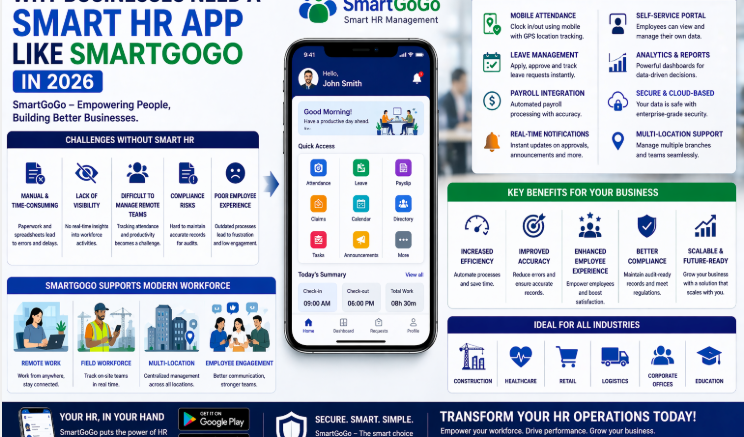
How smartgogo Apps Supports Multi-Site Attendance Management
smartgogo apps is designed with multi-site businesses in mind. The platform enables centralised attendance management while accommodating the distributed nature of modern workforces across Singapore.
Employees use the mobile app to clock in and out from any location. Managers gain real-time visibility into attendance across all their sites through a central dashboard. The system automatically records timestamp, location, and employee identification, eliminating manual data entry and the errors that come with it.
smartgogo apps integrates attendance data with broader workforce management functions, so information flows naturally into payroll, leave management, and reporting. This integration reduces duplicate data entry and ensures consistency across systems.
The platform’s flexibility means it can adapt to your specific business structure and processes, whether you have two locations or twenty, and whether your team works fixed shifts or variable hours.
Best Practices for Implementing a Mobile Clock In App
Simply deploying a mobile clock in app won’t automatically solve your attendance challenges. Success requires thoughtful implementation and ongoing management.
Clear Communication and Training
Before launch, communicate clearly to all employees how the new system works, why it’s being implemented, and what’s expected of them. Provide adequate training so everyone understands how to clock in and out correctly. Address concerns about privacy or monitoring head-on.
Establish Clear Policies
Define and communicate your clock in and clock out procedures, grace periods, and consequences for not clocking in. Ensure consistency across all locations so employees understand that the same standards apply everywhere.
Phase Implementation Strategically
Consider piloting the system at one or two locations before rolling out across all sites. This allows you to identify issues, refine processes, and build confidence before full implementation.
Monitor and Adjust
After implementation, actively monitor the system’s performance. Are employees using it correctly? Are there bottlenecks or confusion points? Use early data to refine processes before problems become entrenched.
Maintain Data Integrity
Establish procedures for correcting legitimate errors (such as a forgotten clock out) while maintaining security. Be clear about who can approve adjustments and under what circumstances.
Conclusion
For multi-site businesses in Singapore, a mobile clock in app transforms attendance management from a source of frustration and error into a streamlined, reliable process. By moving from manual, fragmented systems to a centralised, app-based approach, you reduce errors, prevent time theft, simplify payroll, and gain the visibility you need to manage your distributed workforce effectively.
The investment in implementing a proper mobile clock in app pays dividends through improved accuracy, reduced administrative burden, and stronger compliance. Given the complexity of managing multiple locations, a dedicated system is no longer a luxury—it’s a practical necessity for multi-site businesses operating efficiently in Singapore.
Smart Touch technology pte ltd, www.smartouch.com.sg +65-63964767, sales@smartouch.com.sg, www.smartouch.com.my +607-3889903 sales@smartouch.com.my