How Face Recognition Access Control Singapore Helps Schools and Campuses Enable Contactless Operations
The landscape of educational institutions in Singapore has evolved significantly, particularly following increased awareness around hygiene and operational efficiency. Schools and campuses are now seeking smarter ways to manage access while maintaining safety standards and reducing physical contact points. Face recognition access control technology has emerged as a practical solution that addresses these concerns whilst streamlining campus operations.
For educational leaders, facility managers, and administrators responsible for campus security and day-to-day operations, understanding how biometric facial recognition can transform your institution is increasingly important. This technology not only enhances security but also supports the broader goal of creating safer, more efficient learning environments.
The Challenge: Campus Access Management in Modern Times
Educational institutions in Singapore manage complex access requirements on a daily basis. Schools and campuses typically need to balance several competing priorities:
- Ensuring only authorised personnel and students access secure areas
- Maintaining accurate attendance records and visitor logs
- Minimising physical contact and hygiene risks
- Reducing bottlenecks during peak entry and exit times
- Managing administrative overhead associated with manual access systems
Traditional access methods—such as physical keys, ID cards, or manual sign-in procedures—create friction in daily operations. They also present hygiene concerns when multiple people handle shared items or touch common surfaces. Additionally, manual record-keeping is time-consuming and prone to errors.
Campuses need an access solution that is fast, reliable, contactless, and capable of creating verifiable records without adding administrative burden.
What Is Face Recognition Access Control?
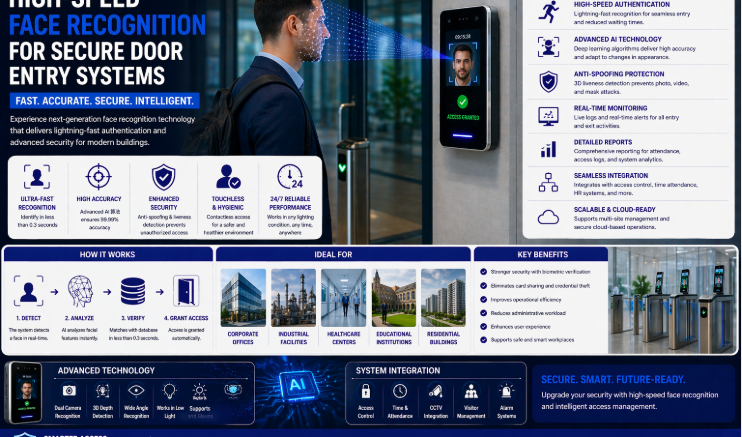
Face recognition access control is a biometric technology that uses facial features to identify and authenticate individuals. Unlike traditional ID cards or keycards, this system requires no physical contact or manual intervention. A person simply approaches the access point, and the system captures and analyses their facial features within seconds.
The technology works by creating a digital profile of an individual’s unique facial characteristics and comparing real-time input against a pre-registered database. If a match is found, access is granted automatically. This process is both fast and non-intrusive.
For educational institutions, this means students and staff can move through campus access points smoothly and safely, without touching doors, card readers, or checkout systems.
Why Contactless Operations Matter for Schools and Campuses
Contactless access is more than a convenience—it represents a fundamental shift in how institutions prioritise health, safety, and operational efficiency.
Health and Hygiene Benefits
Contactless access eliminates the need to touch shared surfaces such as door handles, keypads, or card readers. This is particularly important in educational settings where multiple individuals pass through access points throughout the day. By removing these physical contact points, institutions reduce the transmission of germs and create a healthier campus environment.
Faster Throughput
Face recognition systems process individuals quickly. During busy periods—such as the start of the school day or between classes—this speed reduces congestion at entry points and allows more efficient movement throughout the campus. Students and staff spend less time waiting and more time on their core activities.
Accurate Record-Keeping
Automated facial recognition creates precise, timestamped records of who entered and exited specific areas. This is invaluable for attendance tracking, security audits, and incident investigations. The data is captured automatically without requiring manual effort from staff.
Enhanced Security
Biometric facial recognition is significantly more secure than traditional ID cards, which can be lost, stolen, or shared. A person’s face cannot be forgotten, misplaced, or given to someone else. This makes facial recognition an inherently more robust security measure for protecting school and campus facilities.
Practical Applications in Educational Settings
Main Campus Entrances
Face recognition can be deployed at primary entry and exit points to control who accesses the campus. This is particularly useful during drop-off and pick-up times, or at the beginning and end of the school day.
Classroom and Laboratory Access
Specialised spaces—such as computer labs, science laboratories, or maker spaces—can be secured with facial recognition. Access is granted only to authorised users, and all entry events are logged automatically.
Library and Resource Facilities
Libraries and resource centres can use facial recognition to manage access during non-staffed hours, ensuring only registered users can enter and automating the process of checking in and out.
Visitor Management
Temporary visitors can be registered in the system with facial scans, allowing controlled access to specific areas without requiring manual escort or paper-based sign-in procedures.
Attendance and Punctuality Tracking
Integrated with campus management systems, facial recognition can automatically record student and staff attendance, reducing the need for manual roll calls or separate attendance systems.
How Biometric Facial Recognition Supports Operational Efficiency
Beyond security and hygiene, face recognition access control delivers significant operational benefits for schools and campuses.
Reduced Administrative Overhead: Automated attendance and access logging means less time spent on manual record-keeping. Staff can focus on teaching, learning support, and campus management rather than administrative tasks.
Real-Time Visibility: Campus managers gain real-time insight into who is on campus and where they are at any given time. This is valuable for emergency response, campus safety planning, and resource allocation.
Scalability: As institutions grow, adding new users to a facial recognition system is straightforward—simply enroll new faces into the database. There is no need to issue new cards, manage physical keys, or update complex access matrices.
Integration with Campus Systems: Access data from facial recognition systems can be integrated with student information systems, timetabling software, and facility management platforms, creating a unified digital environment.
Addressing Common Concerns
Accuracy and Lighting
Modern facial recognition systems are designed to work across varying lighting conditions and angles. Quality systems account for glasses, seasonal facial hair, and minor changes in appearance. However, deployment should consider the physical environment and ensure adequate lighting at access points.
Privacy and Data Protection
Educational institutions must ensure that facial data is handled securely and in compliance with Singapore’s data protection frameworks. When implementing such systems, institutions should work with vendors who demonstrate strong data security practices and provide clear transparency about how facial data is stored and used.
Inclusivity and Exceptions
While facial recognition is effective for the majority of users, institutions should have alternative access methods available for individuals who may not be able to use facial recognition. This ensures that all students and staff can access campus facilities regardless of circumstances.
How Smart Touch Technology Singapore Can Help
Smart Touch Technology Singapore offers biometric facial recognition solutions specifically designed for institutional and organisational environments. Their face recognition access control systems provide the combination of security, speed, and contactless operation that schools and campuses require.
By partnering with Smart Touch Technology Singapore, educational institutions can implement reliable, professionally-supported facial recognition access control tailored to campus environments. Their solutions are designed to integrate smoothly with existing campus infrastructure and management systems, minimising disruption during implementation.
If your school or campus is considering contactless access control technology, speaking with experienced providers ensures you select a solution that meets your specific operational and security requirements.
Conclusion
Face recognition access control represents a significant step forward for schools and campuses seeking to enhance security, improve hygiene, and streamline operations. By eliminating physical contact points and automating access and attendance processes, facial recognition technology creates safer, more efficient educational environments.
The benefits extend beyond health and safety to encompass genuine operational improvements—faster throughput, accurate record-keeping, reduced administrative burden, and enhanced security. For Singapore educational institutions committed to providing modern, efficient facilities, biometric facial recognition is a practical and forward-thinking investment.
If you would like to explore how face recognition access control could benefit your school or campus, reach out to Smart Touch Technology Singapore to discuss your specific needs and learn about implementation options suited to your institution.
Smart Touch technology pte ltd , www.smartouch.com.sg +65-63964767, sales@smartouch.com.sg , www.smartouch.com.my +607-3889903 sales@smartouch.com.my