How Face Recognition Access Control Singapore Helps Industrial Sites Strengthen Access Control
Industrial sites across Singapore face mounting pressure to enhance security while maintaining operational efficiency. From manufacturing facilities to logistics hubs and chemical plants, the stakes are high—unauthorised access can lead to theft, equipment damage, safety breaches, and regulatory non-compliance. Traditional access control methods like ID cards and PIN codes are increasingly vulnerable to misuse, cloning, and human error.
Modern industrial operations demand a more robust solution. Face recognition access control technology offers a sophisticated yet practical way for Singapore industrial sites to strengthen their access control systems, protect valuable assets, ensure employee safety, and maintain compliance with local regulations. This article explores how this technology works, why it matters for industrial operations, and how it can be implemented effectively.
Understanding the Challenge of Industrial Access Control
Industrial sites in Singapore operate under unique security pressures. Unlike office environments, industrial facilities often house expensive equipment, sensitive materials, and high-risk work areas. The consequences of inadequate access control extend beyond financial loss—they can affect worker safety and environmental protection.
Common Access Control Problems in Industrial Settings
Many Singapore industrial sites still rely on older access control methods that create significant vulnerabilities:
- Card cloning and loss: Magnetic stripe and basic proximity cards can be duplicated or lost, leaving no clear audit trail of who accessed which areas.
- PIN sharing: Multiple employees may share PIN codes, making it impossible to track individual access and accountability.
- Tailgating: Workers can follow authorised personnel through doors without presenting their own credentials, bypassing security entirely.
- Manual verification delays: Guard-based access verification slows operations and creates bottlenecks, particularly during shift changes or peak activity periods.
- Compliance gaps: Industrial operations in Singapore must maintain detailed access logs for safety and regulatory purposes. Paper-based or poorly integrated systems create compliance risks.
- Temporary access management: Contractors, visitors, and temporary staff require carefully controlled access, which manual systems struggle to handle securely and efficiently.
These issues can undermine both security and productivity. Industrial managers need a solution that is reliable, fast, and creates verifiable records of who accessed which areas and when.
What Is Face Recognition Access Control?
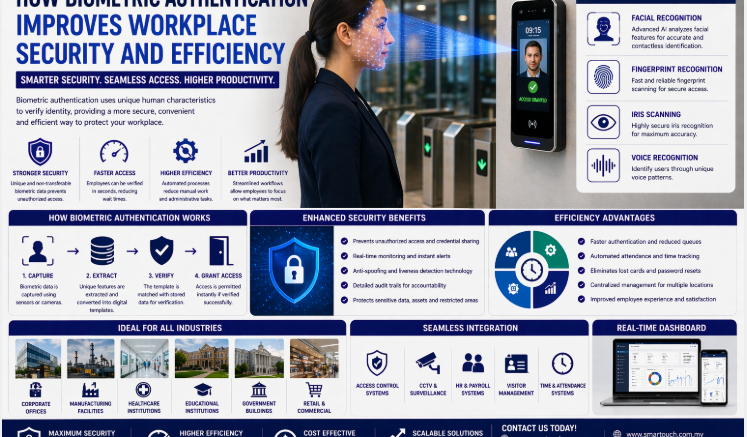
Face recognition access control is a biometric technology that identifies individuals by analysing unique facial features. Unlike cards or codes that can be lost, stolen, or shared, facial biometrics are tied directly to the individual.
How It Works
Face recognition systems capture a digital image of a person’s face as they approach an access point. The system compares this image against an enrolled database of authorised personnel. If there is a match, access is granted. If there is no match or insufficient confidence in the match, access is denied and the attempt is logged.
Modern systems use advanced algorithms to account for variations in lighting, angle, facial hair, glasses, and other factors, ensuring reliable recognition even in industrial environments where conditions may not be ideal.
Key Advantages for Industrial Sites
- Unique identification: Each person’s face is unique, eliminating the risk of card sharing or cloning.
- Speed: Recognition happens in seconds, reducing queuing and operational delays.
- Detailed audit trails: Every access attempt is automatically logged with timestamp and facial data, creating irrefutable records.
- No lost credentials: Workers cannot leave their biometric identity at home or forget it at the end of a shift.
- Integration with workflows: Systems can be integrated with other industrial management tools, from time-and-attendance to equipment access logs.
Why Industrial Sites in Singapore Need Stronger Access Control
Singapore’s industrial sector is highly regulated and operates in a competitive, innovation-driven economy. Security and compliance are not optional—they are essential to business continuity and reputation.
Regulatory and Compliance Considerations
Industrial operations in Singapore must comply with various regulations and guidelines covering workplace safety, environmental protection, and asset security. Access control is a fundamental part of demonstrating compliance. Regulatory bodies expect organisations to maintain detailed, verifiable records of who accessed restricted areas.
While specific access control regulations vary depending on the industry and site classification, the principle remains constant: you must be able to prove who was in which areas and when. Face recognition systems provide this capability automatically and reliably.
Asset and Safety Protection
Industrial sites typically house valuable equipment and materials. Unauthorised access can lead to theft, sabotage, or accidental misuse of machinery. More critically, uncontrolled access to hazardous areas can result in serious injuries or fatalities.
Strong access control—including face recognition—ensures that only trained, authorised personnel can enter high-risk zones. This is particularly important in chemical processing, metal fabrication, and heavy equipment operations.
Operational Continuity
Security breaches, theft, or accidents disrupt operations and damage profitability. A robust access control system reduces these risks and allows industrial operations to run smoothly without constant security concerns.
How Face Recognition Access Control Strengthens Industrial Security
Face recognition technology addresses industrial access control challenges in several practical ways:
Eliminating Tailgating and Unauthorised Access
Because face recognition requires individual identification, it effectively prevents tailgating. Even if someone follows an authorised worker through a doorway, they cannot proceed without their own facial recognition match. This creates a genuine security barrier rather than a reliance on employee vigilance.
Creating Verifiable Accountability
Every access event is logged with a timestamp and facial data. If a security incident occurs, management can immediately determine who was in that area at that specific time. This level of accountability deters misuse and provides crucial evidence for investigations.
Simplifying Temporary Access Management
Contractors, visitors, and temporary staff can be enrolled in the system for specific dates or times. When their access period expires, they are automatically denied entry. There is no need to manually collect and deactivate temporary badges.
Reducing Human Error
Manual access verification relies on human judgment and attention. Face recognition systems make the decision objectively and consistently, eliminating errors caused by distraction, fatigue, or social engineering.
Improving Incident Response
When a security issue arises, face recognition logs provide immediate, detailed information. Management can review access records, identify who was present, and take appropriate action quickly.
Implementing Face Recognition Access Control in Industrial Sites
Planning and Assessment
Successful implementation begins with a thorough assessment of your facility. Consider the size of your site, the number of access points, the variety of personnel (permanent staff, contractors, visitors), and your specific security needs.
Different industrial sites have different requirements. A manufacturing plant with 500 employees and three main entrances has different needs than a logistics hub with rapid daily traffic. Planning ensures you choose the right approach.
Enrolment and System Setup
Face recognition systems require an enrolled database of authorised personnel. During setup, each authorised worker has their face captured and stored securely. This process is non-invasive and typically takes just a few seconds per person.
Role-based access can then be configured, so different employees have access to different areas based on their job functions. A maintenance technician may have access to the machinery area, while administrative staff might not.
Integration with Existing Systems
Modern access control systems can integrate with other industrial management tools. This allows organisations to combine access data with time-and-attendance records, shift reports, and incident logs, creating a comprehensive security picture.
Ongoing Management and Monitoring
Once deployed, the system requires regular monitoring and maintenance. Access logs should be reviewed periodically, staff enrolment should be updated as personnel changes occur, and the system should be maintained according to the manufacturer’s guidelines.
How Smart Touch Technology Singapore’s Face & Door Solution Can Help
Smart Touch Technology Singapore offers a comprehensive face recognition and door access solution designed to meet the security needs of industrial facilities across Singapore.
The Face & Door solution provides reliable biometric identification and access control, allowing industrial sites to strengthen security while maintaining operational efficiency. By implementing this technology, organisations can create detailed access logs, eliminate the vulnerabilities of card-based systems, and ensure that only authorised personnel can enter restricted areas.
Whether you operate a manufacturing facility, logistics hub, or other industrial site, a professional face recognition system can significantly enhance your security posture and provide the audit trails necessary for regulatory compliance.
Want to know more about this product? Click here to learn how Smart Touch Technology’s Face & Door solution can be tailored to your industrial site’s specific needs.
Conclusion
Face recognition access control represents a significant advancement in industrial security. For Singapore industrial sites, the technology addresses longstanding vulnerabilities in traditional access control methods while providing the detailed, verifiable records that regulatory compliance demands.
By eliminating card sharing, preventing tailgating, automating visitor management, and creating comprehensive audit trails, face recognition technology helps industrial organisations protect their assets, ensure worker safety, and maintain operational continuity. The investment in modern access control typically pays for itself through improved security and reduced operational friction.
If your industrial site is still relying on older access control methods, now is the time to consider upgrading to a more robust, reliable solution. Face recognition technology is mature, practical, and increasingly accessible to industrial operations of all sizes across Singapore.
Smart Touch technology pte ltd , www.smartouch.com.sg +65-63964767, sales@smartouch.com.sg , www.smartouch.com.my +607-3889903 sales@smartouch.com.my