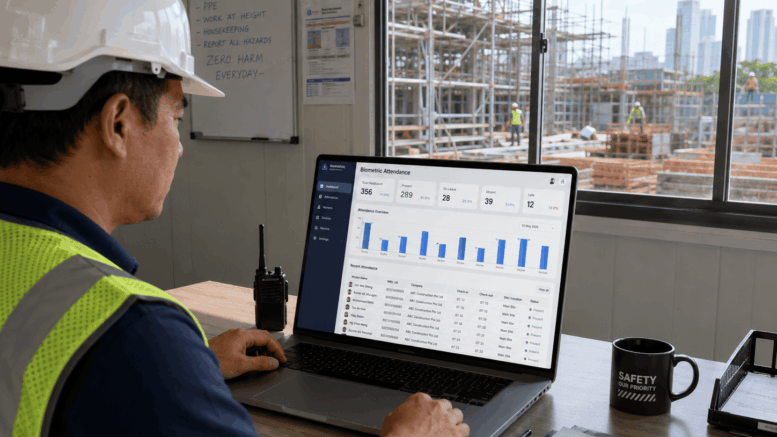
Construction sites face a unique set of security and workforce management challenges. Multiple contractors, rotating shifts, and large numbers of workers moving through a single site make it difficult to track who is actually on-site at any given time. A Biometric Authentication System (BAS) solves this problem by verifying every worker’s identity using fingerprints, facial recognition, or other unique physical traits before granting access. For companies in Singapore looking to tighten site security, reduce time theft, and meet regulatory attendance requirements, investing in the right BAS is no longer optional — it is essential.
In this article, we explain what a Biometric Authentication System is, why construction sites need one, and how to choose the best solution for your project.
What Is a Biometric Authentication System (BAS)?
A Biometric Authentication System is a security solution that verifies a person’s identity using unique biological characteristics, such as fingerprints, facial features, or iris patterns. Unlike ID cards or PINs, which can be shared, lost, or stolen, biometric data cannot be easily duplicated. This makes a BAS one of the most reliable ways to confirm that the person entering a site is exactly who they claim to be.
On construction sites, a BAS is typically used at entry and exit points to log attendance, restrict access to authorised personnel, and generate accurate records for payroll and compliance purposes.
Why Construction Sites Need a Biometric Authentication System
Eliminating Buddy Punching and Time Theft
One of the most common issues on construction sites is “buddy punching,” where one worker clocks in on behalf of an absent colleague. This leads to inflated labour costs and inaccurate manpower records. Because biometric data is unique to each individual, a BAS makes it virtually impossible for one worker to clock in for another.
Improving Site Safety and Accountability
Knowing exactly who is on-site at all times is critical during emergencies such as fires or accidents. A BAS provides real-time attendance data, helping site managers account for every worker quickly and accurately.
Meeting Regulatory and Audit Requirements
Many construction projects in Singapore are subject to manpower audits and regulatory checks. A biometric authentication system for construction sites automatically generates accurate, tamper-proof attendance logs that simplify compliance reporting.
Key Benefits of a BAS for Construction Sites
| Benefit | Impact on Your Site |
|---|---|
| Accurate Attendance Tracking | Removes manual errors and eliminates buddy punching |
| Enhanced Site Security | Restricts access to verified, authorised personnel only |
| Faster Emergency Headcounts | Real-time data shows exactly who is on-site |
| Simplified Payroll Processing | Automated logs reduce administrative workload |
| Regulatory Compliance | Tamper-proof records support audits and inspections |
Key Features to Look For in a BAS
- Multiple verification modes (fingerprint, facial recognition, or both) for flexibility in outdoor and dusty environments
- Weatherproof and rugged hardware built to withstand construction site conditions
- Cloud-based data storage for remote monitoring and reporting
- Integration with payroll and HR systems to streamline administration
- Fast recognition speed to avoid bottlenecks during shift changes
BAS vs Traditional Attendance Methods
| Feature | Biometric Authentication System | Traditional Card/Paper System |
|---|---|---|
| Accuracy | High — unique to each worker | Low — cards can be shared |
| Fraud Prevention | Strong | Weak |
| Reporting | Automated, real-time | Manual, time-consuming |
| Maintenance | Minimal, cloud-managed | Ongoing card replacement costs |
Best Practices for Implementing a BAS on Site
- Assess your site layout to determine the number and placement of biometric terminals needed.
- Choose a system rated for outdoor use if terminals will be exposed to dust, heat, or rain.
- Register all workers and subcontractors during onboarding to avoid access delays.
- Integrate the BAS with your existing payroll or workforce management software.
- Train site supervisors on how to review attendance reports and manage exceptions.
Key Takeaways
- A Biometric Authentication System verifies worker identity using fingerprints or facial recognition, eliminating buddy punching.
- It improves site safety by providing accurate, real-time headcounts during emergencies.
- Cloud-based reporting simplifies payroll processing and regulatory compliance.
- Choosing rugged, weatherproof hardware is essential for outdoor construction environments.
Conclusion
A reliable Biometric Authentication System is one of the smartest investments a construction company can make. It closes the gaps left by traditional attendance methods, prevents time theft, strengthens on-site security, and gives management the accurate data needed for compliance and payroll. As construction sites in Singapore continue to face tighter manpower regulations and safety expectations, adopting a purpose-built BAS is a practical step toward a more secure and efficient worksite.
If you are ready to upgrade your site’s attendance and security systems, a trusted biometric authentication system provider can help you find the right fit for your project.
Frequently Asked Questions
1. What is the main advantage of a biometric authentication system over ID cards?
Biometric data is unique to each individual and cannot be shared or duplicated, unlike ID cards, which significantly reduces fraud and time theft.
2. Can a BAS work outdoors on a construction site?
Yes. Many biometric terminals are designed with weatherproof and rugged casings specifically for outdoor and dusty environments common on construction sites.
3. Does a BAS integrate with payroll systems?
Most modern biometric authentication systems offer integration with payroll and HR software, allowing attendance data to flow directly into salary calculations.
4. How long does it take to set up a BAS on a new site?
Installation and worker registration can typically be completed within a few days, depending on the size of the workforce and number of access points.
5. Is biometric data secure and compliant with privacy regulations?
Reputable BAS providers store biometric data securely, often using encryption, and design their systems to comply with data protection regulations such as Singapore’s PDPA.
Learn more about this product—click here: https://smartouch.com.sg/bas/
Smart Touch technology pte ltd , www.smartouch.com.sg +65-63964767, sales@smartouch.com.sg , www.smartouch.com.my +607-3889903 sales@smartouch.com.my