Introduction
Security remains a top priority for commercial building managers across Singapore. Whether you operate an office tower, retail complex, or mixed-use development, controlling who enters your premises is essential for protecting assets, ensuring employee safety, and maintaining operational efficiency.
Traditional access control systems—such as key cards, PIN codes, and manual security checks—have served businesses well for decades. However, these methods come with significant limitations. Cards can be lost or stolen. Codes can be shared or forgotten. Manual verification is slow and prone to human error.
Face recognition access control technology offers a modern alternative. By identifying individuals based on their unique facial features, this technology provides faster, more secure, and more convenient entry management for commercial buildings. As we move into 2026, face recognition systems have become increasingly reliable, affordable, and practical for Singapore businesses of all sizes.
This article explores why face recognition access control is becoming the preferred choice for commercial buildings in Singapore, how it works, and how your organisation can implement this technology effectively.
Why Face Recognition Access Control Matters for Singapore Commercial Buildings
The Growing Security Challenge
Singapore’s commercial sector is dynamic and fast-paced. Employees, contractors, clients, and visitors move through buildings daily. Managing access for this constant flow of people using traditional methods creates bottlenecks and security gaps.
Unauthorised entry remains a genuine concern. Tailgating—where unauthorised individuals follow legitimate employees through secure doors—is a common vulnerability. Shared access credentials make it difficult to track who actually entered your building and when. And stolen or lost access cards create security risks until they are cancelled and replaced.
Face recognition access control addresses these challenges by providing a contactless, difficult-to-spoof method of identifying individuals at entry points.
Operational Efficiency and Employee Experience
Beyond security, face recognition systems streamline daily operations. Employees no longer need to carry physical access cards or remember PIN codes. They simply walk up to a reader, and the system identifies them within seconds. This speeds up entry, reduces queuing during peak hours, and eliminates the frustration of forgotten or misplaced cards.
For building managers, this means fewer access-related support requests and smoother building operations.
How Face Recognition Access Control Works
The Technology Behind Facial Identification
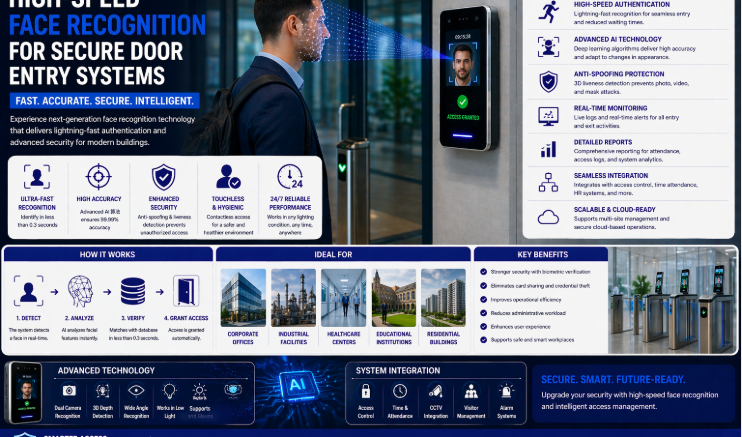
Face recognition systems capture and analyse facial features such as the distance between eyes, nose shape, cheekbone structure, and jawline. This data is converted into a unique digital template for each individual. When someone approaches an access point, the system captures their face in real time, compares it to enrolled templates, and makes an identification decision within milliseconds.
Modern systems use advanced algorithms to handle variations in lighting, angles, facial expressions, and even minor changes in appearance such as glasses or facial hair.
Integration with Access Control Infrastructure
Face recognition systems integrate with your existing access control infrastructure. When the system identifies an authorised individual, it sends a signal to unlock the door or gate. If the person is not recognised, access is denied and an alert may be triggered.
Most systems maintain detailed logs of every entry attempt, recording who accessed the building, when, and from which entrance. This audit trail is invaluable for security investigations and compliance reporting.
Key Benefits for Commercial Buildings in Singapore
Enhanced Security
Face recognition provides a high level of security because facial features cannot be easily duplicated or shared. Spoofing attempts using photographs or video are defeated by liveness detection technology, which confirms that the face being scanned is a real, living person.
The system reduces unauthorised entry attempts and tailgating. Building occupants also benefit from knowing that access is strictly controlled and monitored.
Speed and Convenience
Employees and authorised visitors experience faster, frictionless entry. There is no card to tap, no code to enter, and no waiting for manual verification. This is particularly valuable during peak hours when many people are entering or leaving the building simultaneously.
Reduced Administrative Burden
Managing physical access cards is time-consuming. Cards need to be issued, renewed, deactivated when employees leave, and replaced when lost. Face recognition eliminates most of this administrative overhead. Enrollment is simple—typically requiring just a few photographs—and deprovisioning is as straightforward as removing someone from the system database.
Comprehensive Audit Trails
Every face recognition event is logged with date, time, and identification details. This creates a complete record of building access, which is essential for security investigations, incident response, and regulatory compliance.
Scalability
Whether your commercial building has one entrance or dozens of access points, face recognition systems scale easily. Adding new entry points or expanding coverage requires minimal additional infrastructure compared to traditional card-based systems.
Addressing Common Concerns About Face Recognition
Accuracy and False Rejections
A common concern is whether face recognition systems misidentify people or reject legitimate users. Modern systems achieve high accuracy rates, particularly those using multi-factor verification that combines face recognition with additional confirmation methods. The risk of false rejections can be further reduced through proper system calibration, good lighting at entry points, and appropriate camera positioning.
Privacy Considerations
Organisations implementing face recognition in Singapore should be transparent with employees and visitors about the system’s use. Clearly communicate where cameras are positioned, what data is collected, how long it is retained, and how it will be used. Ensure that data handling practices comply with relevant Singapore data protection requirements. Consult with your legal and compliance team to verify alignment with your organisation’s privacy policies and applicable regulations.
Implementation Considerations
Successful face recognition deployment requires careful planning. Ensure adequate lighting at all access points, maintain clean camera lenses, and position readers at appropriate heights and distances. Train staff and users on the system’s operation and benefits. Have contingency procedures in place for system failures or power outages.
Face Recognition Access Control for Different Building Types
Corporate Office Buildings
Office towers benefit significantly from face recognition systems. Employees appreciate the speed and convenience, security teams gain better access visibility, and management reduces lost card incidents. The technology supports flexible working arrangements by making it easy for employees to access the building at any time.
Mixed-Use Developments
Buildings housing offices, retail, and residential spaces can use face recognition for secure areas while maintaining different access protocols for public and private zones. Residents enjoy keyless entry, office tenants benefit from secure floor access, and building management maintains comprehensive security oversight.
Data Centres and Critical Infrastructure
Facilities housing sensitive equipment or data require especially robust access control. Face recognition combined with multi-factor authentication provides the high security standards these environments demand.
How Smart Touch Technology Singapore Can Help
Smart Touch Technology offers face and door access control solutions designed specifically for Singapore commercial buildings. The Face & Door system integrates facial recognition technology with comprehensive access management, providing building managers with a modern, reliable solution for controlling entry to their premises.
The system is built to handle the practical requirements of busy commercial environments. It supports fast identification, maintains detailed audit logs, and integrates with your existing building infrastructure. Whether you are upgrading an older access control system or implementing modern security for a new building, the Face & Door system delivers the security, convenience, and operational efficiency that Singapore businesses expect.
Want to know more about this product? Click here to learn how the Face & Door system can enhance security and streamline access control for your commercial building.
Conclusion
Face recognition access control has moved from emerging technology to practical necessity for modern commercial buildings in Singapore. It delivers genuine security improvements, streamlines daily operations, and enhances the experience for employees and authorised visitors.
As you plan your building’s security infrastructure for 2026 and beyond, face recognition should be a key consideration. The technology is mature, the benefits are clear, and implementation challenges are well understood.
Whether you manage a single office building or a complex development, face recognition access control offers a forward-thinking solution that addresses current security and operational needs while positioning your building as a modern, professionally managed facility.
Smart Touch technology pte ltd , www.smartouch.com.sg +65-63964767, sales@smartouch.com.sg , www.smartouch.com.my +607-3889903 sales@smartouch.com.my