Choosing the Right Construction Biometric Authentication System for Retail Businesses
Retail businesses in Singapore face increasingly complex security challenges. Protecting valuable inventory, securing employee access to restricted areas, and maintaining accurate records of who enters and exits your premises are critical concerns for any retail operation. While retail environments differ from traditional construction sites, many retail businesses benefit from implementing robust biometric authentication systems—technology originally developed for construction site management and access control.
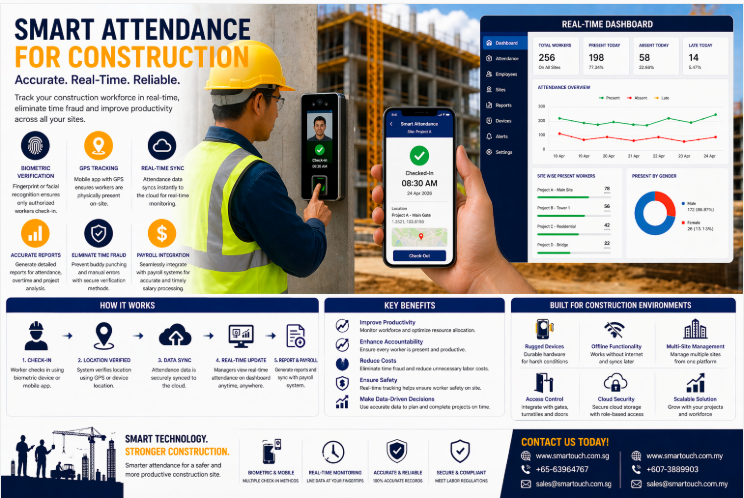
A construction biometric authentication system (BAS) offers retail businesses a modern, reliable solution for workforce management and premises security. These systems use fingerprint, facial recognition, or other biometric data to verify employee identity, streamline time and attendance tracking, and maintain comprehensive access logs. For retail operators managing multiple staff members across shift changes, this technology can significantly improve operational efficiency while reducing security risks.
This guide explores how to choose the right biometric authentication system for your retail business and why this investment matters in Singapore’s competitive retail landscape.
Why Retail Businesses Need Biometric Authentication Systems
Modern retail operations involve complex staffing requirements, inventory management challenges, and security concerns that traditional access control methods struggle to address effectively. Biometric authentication systems provide a practical answer to several pressing retail management issues.
Workforce Management and Accountability
Retail businesses typically employ numerous staff members working various shifts. Tracking attendance manually is time-consuming and prone to errors. Employees may forget to clock in or out, or supervisors might miss attendance discrepancies. A biometric authentication system automatically records when each employee enters and exits the premises, creating an accurate, tamper-proof attendance record.
This automatic tracking eliminates disputes about working hours and simplifies payroll processing. It also helps managers identify patterns—such as chronic lateness or unexplained absences—that might require attention.
Enhanced Security and Access Control
Retail environments often contain secure areas: stockrooms, offices, cash handling areas, or sections containing high-value merchandise. Restricting access to authorised personnel only is essential for loss prevention and operational security. Biometric systems ensure that only employees with appropriate clearance can access these areas, and every access attempt is logged.
Unlike key cards or PIN codes that can be lost, shared, or stolen, biometric identifiers are unique to each individual and cannot be easily transferred or misused.
Regulatory Compliance and Record Keeping
Retail businesses in Singapore must comply with various employment regulations and potentially industry-specific compliance requirements. Maintaining accurate, auditable records of employee attendance and access is essential for demonstrating compliance during inspections or investigations. Biometric systems create detailed, timestamped records that provide clear evidence of adherence to workplace policies and regulations.
Key Features to Look for in a Retail Biometric Authentication System
Not all biometric systems are created equal. When evaluating options for your retail business, consider these essential features:
Reliability and Accuracy
Your biometric system must accurately identify employees under real-world conditions. Retail environments can present challenges: employees may wear gloves, have different lighting conditions throughout the store, or be in a hurry during busy periods. Choose a system with proven accuracy rates and robust matching algorithms that handle these variables effectively.
Speed of Authentication
Retail staff members move quickly between areas and need rapid access verification. A system that requires lengthy authentication processes will frustrate employees and slow operations. Look for solutions offering fast biometric matching—ideally within seconds—so access is granted swiftly without creating bottlenecks.
Integration with Existing Systems
Most retail businesses already use point-of-sale (POS) systems, employee management software, or other operational tools. Your biometric authentication system should integrate smoothly with these existing platforms, allowing data to flow seamlessly between systems rather than requiring manual data entry or workarounds.
Scalability
If your retail business operates multiple locations or plans to expand, your biometric system should scale accordingly. The system should support adding new locations, increasing the number of users, and expanding functionality without requiring a complete replacement.
User-Friendly Interface
Both employees and managers need to interact with the biometric system regularly. An intuitive interface reduces training time and encourages proper use. Complex systems often lead to workarounds and resistance from staff members.
Data Security and Privacy Compliance
Biometric data is highly sensitive personal information. Your system must employ robust encryption, secure data storage, and appropriate access controls to protect employee information. Ensure the system complies with Singapore’s Personal Data Protection Act (PDPA) and other relevant privacy regulations. For the latest requirements, refer to the Personal Data Protection Commission Singapore (PDPC) website.
Common Challenges in Implementing Biometric Systems for Retail
Understanding potential obstacles helps you plan a successful implementation:
Employee Acceptance and Privacy Concerns
Some employees may resist biometric systems due to privacy concerns or unfamiliarity with the technology. Transparent communication about how the system works, what data is collected, how it is protected, and why it benefits the business helps address these concerns. Emphasise that biometric systems are standard in modern workplaces and that data protection is a priority.
Initial Implementation Costs
Biometric systems require upfront investment in hardware, software, and installation. However, this investment typically delivers returns through improved efficiency, reduced labour costs, and enhanced security. Calculate the total cost of ownership over several years, factoring in labour savings and loss prevention benefits.
Maintenance and Technical Support
Like any technology system, biometric solutions require ongoing maintenance, software updates, and technical support. Choose a provider offering reliable support services and clear maintenance protocols.
Integration Complexities
If your retail operation uses multiple systems—CCTV, access control, POS, HR management software—integrating the biometric system with all of these can be complex. Select a system designed with integration capabilities and work with experienced implementation partners.
Practical Implementation Steps for Retail Businesses
Implementing a biometric authentication system successfully requires careful planning:
- Assess Your Needs: Identify which areas of your retail business would benefit most from biometric access control and what specific problems you aim to solve.
- Evaluate Available Solutions: Compare systems based on accuracy, speed, integration capabilities, and cost. Request demonstrations from multiple providers.
- Plan for Change Management: Develop a communication strategy explaining the system to employees, including training and rollout timelines.
- Ensure Compliance: Verify that your chosen system complies with Singapore’s PDPA and any other relevant regulations. Consult with your legal or compliance team if needed.
- Pilot Testing: Consider implementing the system in one location or department first to identify and resolve issues before full-scale deployment.
- Train Your Team: Provide comprehensive training for both employees and managers on system usage, troubleshooting, and data management.
- Monitor and Optimise: After implementation, monitor system performance, gather feedback, and make adjustments to maximise benefits.
How Smart Touch Technology Singapore Can Support Your Retail Business
Smart Touch Technology Singapore offers a comprehensive Biometric Authentication System (BAS) designed to meet the access control and workforce management needs of modern retail businesses. The BAS solution provides reliable biometric verification, seamless integration with existing retail management systems, and secure data handling that complies with Singapore’s privacy requirements.
Whether you operate a single retail location or manage multiple stores, Smart Touch Technology’s BAS can scale to your needs. The system delivers fast, accurate authentication, intuitive interfaces for staff, and detailed reporting capabilities that support effective workforce management and security oversight.
Learn more about this product—click here to explore how Smart Touch Technology’s Biometric Authentication System can enhance security and efficiency in your retail business.
Conclusion
Choosing the right biometric authentication system is an important decision for retail businesses in Singapore. By implementing a reliable system tailored to your operational needs, you can enhance security, improve workforce management, streamline attendance tracking, and strengthen compliance with regulatory requirements.
The key to successful implementation lies in selecting a solution that offers accuracy, speed, integration capabilities, and strong data security. Taking time to evaluate your needs, compare available options, and plan your rollout carefully will help you realise the full benefits of this technology.
Smart Touch Technology Singapore pte ltd, www.smartouch.com.sg +65-63964767, sales@smartouch.com.sg, www.smartouch.com.my +607-3889903 sales@smartouch.com.my