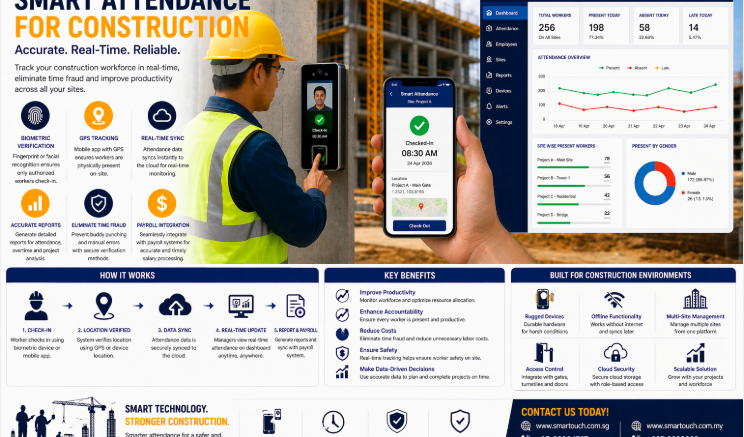
Construction Biometric Authentication System Installation Guide for Distribution Warehouses
Introduction
Distribution warehouses across Singapore handle significant volumes of valuable inventory daily. Ensuring secure access to these facilities is a critical operational priority for warehouse managers, facility directors, and business owners. Traditional access control methods—such as key cards, PIN codes, and manual sign-in sheets—present substantial security gaps and create administrative overhead that slows operational efficiency.
Biometric authentication systems offer a modern, reliable alternative that eliminates many of these vulnerabilities. By using unique physical characteristics for identification, biometric systems provide a level of security that is difficult to compromise and virtually impossible to duplicate or share between unauthorised users.
For Singapore’s competitive logistics and warehousing sector, implementing a robust biometric authentication system can be a significant strategic advantage. This guide explains what a construction biometric authentication system is, why it matters for distribution warehouses, and how to plan and execute an installation that meets your operational needs.
Understanding Biometric Authentication Systems in Warehouse Environments
What Is a Biometric Authentication System?
A biometric authentication system uses distinctive physical or behavioural characteristics to verify and identify individuals. Common biometric identifiers include fingerprints, facial recognition, iris or retinal patterns, and hand geometry. Unlike passwords or access cards, biometric data cannot be forgotten, lost, stolen, or easily replicated.
In a warehouse context, biometric systems integrate with access control infrastructure to grant or deny entry based on verified identity. Authorised personnel can enter secure areas without requiring physical credentials, while the system maintains a comprehensive, tamper-proof audit trail of all access events.
Why Biometric Systems Matter for Distribution Warehouses
Distribution warehouses operate with unique security challenges. Multiple employees, contractors, delivery personnel, and visitors move through facilities throughout the day. Managing access to high-value inventory, restricted areas, and sensitive equipment requires both stringent control and operational efficiency.
Traditional access control methods fall short in several ways. Key cards can be shared, lost, or stolen. PIN codes may be written down or compromised. Manual sign-in processes create administrative burden and provide unreliable records. These gaps expose warehouses to inventory loss, unauthorised access, and compliance risks.
Biometric authentication addresses these challenges directly by ensuring that only verified, authorised individuals can access controlled areas, whilst maintaining detailed, irrefutable records of who accessed what and when.
Key Benefits of Biometric Authentication for Distribution Warehouses
Enhanced Security: Biometric identifiers are unique and cannot be easily forged or transferred between users, reducing the risk of unauthorised access and inventory loss.
Operational Efficiency: Employees gain faster access without fumbling for cards or remembering codes, reducing congestion at entry points and improving workflow.
Audit Trail and Compliance: Biometric systems create immutable records of access events, supporting regulatory compliance and internal investigations when needed.
Reduced Administrative Overhead: No need to replace lost cards, reset forgotten codes, or manage manual access logs. Biometric systems automate these processes.
Cost Savings Over Time: Whilst initial installation requires investment, reduced credential replacement costs and improved operational efficiency yield long-term savings.
Visitor and Contractor Management: Temporary biometric credentials can be easily created and revoked, simplifying access for non-permanent personnel.
Planning Your Biometric System Installation
Assess Your Warehouse Layout and Access Points
Begin by mapping your distribution warehouse and identifying all locations where access control is necessary. This typically includes:
- Main entrance gates
- Employee access points
- High-value inventory storage areas
- Administrative offices
- Equipment rooms
- Loading dock entries
- Restricted zones
For each access point, assess the daily traffic volume and determine whether the biometric system will be the primary control method or will work alongside existing infrastructure.
Define Your Security Requirements
Different areas of your warehouse may require different levels of security. An employee break room might need basic access control, whilst the high-value inventory zone requires more rigorous verification. Consider:
- Who needs access to which areas
- Whether access should be time-restricted
- How to handle emergency situations requiring rapid override
- Audit and reporting requirements for compliance
Choose the Right Biometric Technology
Fingerprint recognition is a popular choice for warehouses because it is reliable, fast, and widely understood by staff. Facial recognition can work well for high-traffic areas but may require additional lighting and clear sightlines. Consider your warehouse environment—dust, temperature fluctuations, and moisture levels can affect some biometric technologies.
Evaluate vendors based on system accuracy, processing speed, integration capabilities, and local support availability in Singapore.
Budget and Obtain Approvals
Biometric system installation involves hardware costs (readers, controllers, door locks), software licensing, installation labour, and training. Obtain quotes from qualified installers and factor in ongoing maintenance and support. Secure budget approval and ensure stakeholder buy-in from management, IT, and warehouse operations teams.
Installation Considerations for Distribution Warehouses
Environmental Factors
Distribution warehouses often experience challenging environmental conditions. High humidity, temperature fluctuations, dust, and occasional water exposure can affect biometric hardware. Ensure chosen devices are rated for warehouse environments and install protective housings where necessary. Consider whether outdoor access points require weatherproof equipment.
Network Infrastructure
Biometric systems typically require network connectivity to function properly. Plan your network infrastructure to support biometric readers at all access points. Consider whether you will use wired connections, wireless systems, or a hybrid approach. Ensure adequate bandwidth and system redundancy so that access control remains functional even if primary network connections are temporarily disrupted.
Power Requirements
Biometric readers and electronic locks require reliable power supply. Identify power sources near each access point and ensure they are adequate. Consider backup power (battery or generator systems) for critical access points so that entry and exit remain controlled even during power outages.
Integration with Existing Systems
Your biometric system should integrate seamlessly with existing warehouse management systems, security systems, and time-tracking systems where possible. This reduces redundancy, improves data accuracy, and enhances operational visibility.
Common Installation Challenges and Solutions
Challenge: High Staff Turnover
Solution: Biometric systems excel in high-turnover environments because credentials can be instantly revoked when personnel depart. There is no need to recover physical cards or reset access codes. Simply remove the employee from the system and access is immediately denied.
Challenge: Contractor and Visitor Access
Solution: Temporary biometric credentials can be enrolled quickly and set to expire automatically after a specified date. This provides controlled access for non-permanent personnel without compromising security or burdening administrative staff.
Challenge: Equipment Reliability in Harsh Conditions
Solution: Select biometric hardware specifically rated for industrial or warehouse environments. Install protective covers at exposed points, schedule regular maintenance, and ensure your vendor provides local technical support in Singapore for rapid issue resolution.
Challenge: Staff Resistance to New Technology
Solution: Comprehensive training and clear communication about benefits reduce resistance. Demonstrate how biometric systems save time at access points and reduce frustration with lost credentials. Frame the change as a positive modernisation that improves workplace efficiency.
How Smart Touch Technology Can Support Your Installation
Smart Touch Technology Singapore provides the Biometric Authentication System (BAS), a comprehensive solution designed specifically for organisations like distribution warehouses that require reliable, scalable access control.
The BAS solution enables you to implement secure, efficient biometric authentication across your facility. By partnering with Smart Touch Technology for your installation, you benefit from local expertise, professional implementation, and ongoing support tailored to Singapore’s business environment.
Whether you are securing a single warehouse or managing access across multiple distribution centres, the BAS platform provides the flexibility and reliability you need to protect your assets whilst streamlining daily operations.
Learn more about this product—click here.
Best Practices for Successful Implementation
- Start with a Pilot: Implement the system at one or two access points first. Gather feedback from users, identify issues, and refine the process before full rollout.
- Invest in Training: Ensure all staff understand how to use the biometric readers. Clear signage and brief training sessions reduce frustration and user errors.
- Establish Clear Policies: Define access rights for different roles, procedures for handling access denials, and protocols for system emergencies.
- Plan for Maintenance: Schedule regular cleaning and maintenance of biometric hardware to ensure reliable operation in your warehouse environment.
- Monitor and Audit: Regularly review access logs to identify unusual patterns, verify that access rights match current staffing, and ensure compliance with your security policies.
- Keep Backup Processes: Even with a reliable system, maintain backup access procedures (such as temporary override capabilities) for emergencies and system downtime.
Conclusion
Biometric authentication systems represent a significant step forward in warehouse access control. For Singapore distribution warehouses seeking to enhance security, improve operational efficiency, and reduce administrative overhead, biometric technology offers a proven solution that addresses the limitations of traditional access methods.
A successful installation begins with careful planning—assessing your facility layout, defining security requirements, selecting appropriate technology, and preparing your team for change. By addressing common challenges proactively and following best practices, you can implement a system that reliably protects your assets whilst streamlining daily operations.
Whether you are securing high-value inventory, managing contractor access, or simplifying employee entry, biometric authentication can deliver measurable benefits to your warehouse operation. The key is selecting a reliable solution and partner that understands your specific needs.
Smart Touch technology pte ltd , www.smartouch.com.sg +65-63964767, sales@smartouch.com.sg , www.smartouch.com.my +607-3889903 sales@smartouch.com.my