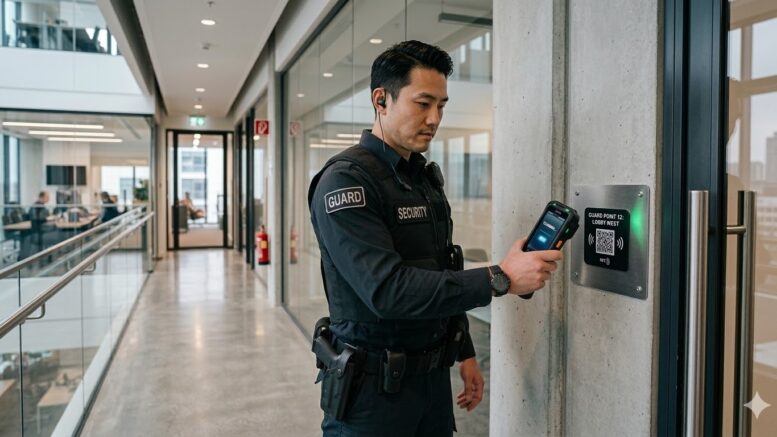
Paper-based patrol logs make it nearly impossible for security companies to prove that guards actually completed their rounds on time. A digital guard patrol reporting system solves this problem by recording every checkpoint scan, timestamp, and incident note in real time, giving security firms and their clients verifiable proof of coverage. This article explains how digital guard patrol systems work, why security companies in Singapore are adopting them, and what features matter most when choosing one.
What Is a Digital Guard Patrol Reporting System?
A digital guard patrol reporting system uses checkpoints — such as NFC tags, QR codes, or GPS coordinates — that guards scan during their rounds using a mobile app or handheld device. Each scan is timestamped and uploaded to a central dashboard, creating an accurate, tamper-proof record of every patrol.
Why Security Companies Need a Digital Patrol System
Verifiable Proof of Patrol Completion
Clients increasingly demand proof that contracted patrol rounds are actually completed. Digital patrol systems provide timestamped, GPS-verified records that eliminate disputes over missed checkpoints.
Faster Incident Reporting
Guards can log incidents, take photos, and submit reports directly from their mobile device during patrol, allowing supervisors to respond to issues immediately rather than waiting for an end-of-shift report.
Improved Guard Accountability
Real-time tracking discourages guards from skipping checkpoints or falsifying patrol times, since every scan is logged with an accurate timestamp and location.
Key Benefits of a Digital Guard Patrol System
| Benefit | Impact |
|---|---|
| Verified Patrol Records | Provides proof of coverage for clients and audits |
| Real-Time Incident Reporting | Speeds up response to security issues |
| GPS and Timestamp Tracking | Prevents falsified or skipped checkpoints |
| Centralised Dashboard | Supervisors monitor multiple sites from one screen |
| Automated Reporting | Reduces paperwork and administrative workload |
Key Features to Look For
- Mobile app for guards with offline scanning capability for areas with poor signal
- NFC, QR code, or GPS checkpoint options to suit different site layouts
- Real-time alerts for missed checkpoints or overdue rounds
- Incident reporting with photo uploads for detailed documentation
- Client-facing reports that can be shared to demonstrate patrol compliance
Digital Patrol System vs Manual Logbooks
| Feature | Digital Patrol System | Manual Logbook |
|---|---|---|
| Verification | GPS and timestamp verified | Easily falsified |
| Incident Reporting | Instant, with photos | Delayed, handwritten |
| Client Reporting | Automated digital reports | Manual compilation |
| Supervisor Visibility | Real-time dashboard | None until shift ends |
Best Practices for Rolling Out a Digital Patrol System
- Map out all checkpoints across each client site before installation.
- Choose a checkpoint technology (NFC, QR, or GPS) suited to the site’s environment.
- Train guards thoroughly on the mobile app, including incident reporting features.
- Set up real-time alerts for missed or delayed checkpoints.
- Share patrol reports with clients regularly to reinforce trust and transparency.
Key Takeaways
- Digital guard patrol systems provide verifiable, tamper-proof proof of patrol completion.
- Real-time incident reporting speeds up response times to security issues.
- GPS and timestamp tracking improve guard accountability significantly.
- Automated client reports strengthen trust and reduce administrative workload.
Conclusion
A reliable digital guard patrol reporting system gives security companies in Singapore the tools to prove patrol compliance, respond faster to incidents, and build stronger trust with clients. By replacing manual logbooks with verified, real-time data, security firms can operate more efficiently while demonstrating the value of their service. As client expectations for transparency continue to rise, digital patrol reporting is quickly becoming a standard requirement for professional security operations.
Frequently Asked Questions
1. What checkpoint technologies are used in digital patrol systems?
Most systems use NFC tags, QR codes, or GPS coordinates, depending on the site layout and connectivity available.
2. Can guards use the system without an internet connection?
Many mobile apps support offline scanning, syncing data automatically once connectivity is restored.
3. How does the system help with client reporting?
Digital patrol systems generate automated reports showing completed checkpoints, timestamps, and incidents, which can be shared directly with clients.
4. Is guard location data kept private and secure?
Reputable providers encrypt location and patrol data and follow data protection regulations to keep information secure.
5. How long does it take to set up a digital patrol system across multiple sites?
Setup time varies by site count, but most companies can deploy checkpoints and train guards within one to two weeks.
Need more information about the product? Click here: https://smartouch.com.sg/guard-patrol-system
Smart Touch technology pte ltd , www.smartouch.com.sg +65-63964767, sales@smartouch.com.sg , www.smartouch.com.my +607-3889903 sales@smartouch.com.my