Introduction
Security is a top priority for any modern office in Singapore. As businesses grow and workplace flexibility increases, organisations face a genuine challenge: how do you manage who enters and exits your premises efficiently while maintaining strict security standards?
Traditional access control methods—such as key cards, PIN codes, and manual security checks—are becoming outdated. They’re time-consuming, prone to human error, and create security vulnerabilities when cards are lost or codes are compromised. For busy Singapore offices managing dozens or hundreds of employees across multiple floors and departments, these old systems simply don’t scale.
Face recognition door control systems represent a modern, secure, and practical solution to this challenge. By leveraging advanced biometric technology, these systems provide seamless access management that’s both more secure and more convenient than traditional methods. For Singapore businesses, especially those in the financial services, technology, healthcare, and corporate sectors, implementing a face recognition door control system can significantly enhance workplace security whilst streamlining daily operations.
What is a Face Recognition Door Control System?
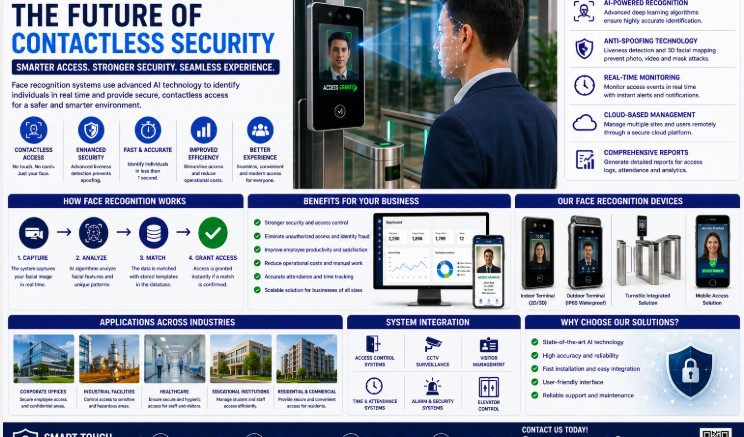
A face recognition door control system uses advanced biometric technology to identify individuals based on their unique facial features. Rather than requiring employees to carry key cards or remember PIN codes, the system captures and analyses facial data to grant or deny access to secured areas.
When an employee approaches a secured door equipped with face recognition technology, the system:
- Captures a real-time image of the person’s face
- Analyses unique facial characteristics and patterns
- Compares the captured data against an authorised database
- Grants access within milliseconds if there’s a match
- Logs the access event for security and compliance records
The entire process typically takes just one or two seconds, allowing employees to move through access points naturally without delays or friction.
Why Singapore Offices Need Modern Door Control Systems
The Security Challenge in Modern Workplaces
Singapore’s regulatory environment and business expectations demand high security standards. Organisations handling sensitive data, financial information, or intellectual property must ensure that only authorised personnel access restricted areas. Yet balancing security with employee convenience remains a constant tension.
Traditional card-based systems create several vulnerabilities:
- Lost or stolen access cards can be misused before being revoked
- Cards can be shared or loaned to unauthorised individuals
- Manual monitoring of access points is labour-intensive and unreliable
- PIN codes can be observed or guessed
- No reliable way to verify that the person using the card is authorised
Face recognition technology eliminates many of these risks by making the individual—not an object they carry—the key to access.
Workplace Efficiency and Employee Experience
Beyond security, Singapore businesses increasingly recognise that workplace technology should enhance the employee experience. Lengthy queues at security checkpoints waste time and reduce productivity. Employees becoming frustrated with cumbersome access procedures affects morale.
A modern face recognition door control system streamlines daily operations. Employees can move through access points quickly and conveniently, whilst the organisation maintains robust security records and audit trails.
Key Benefits of Face Recognition Door Control Systems
Enhanced Security and Access Control
Face recognition is significantly more difficult to spoof or bypass than traditional methods. Since each person’s facial features are unique, unauthorised access becomes much harder to achieve. The system creates a clear, timestamped audit trail of who accessed what areas and when—essential information for compliance and security investigations.
Improved Operational Efficiency
Without the need to carry cards or remember codes, employees experience frictionless access. This reduces bottlenecks at entry points and improves the flow of people through your office. For large organisations or buildings with multiple access points, this efficiency gain is significant.
Reduced Administrative Burden
Managing physical key cards—issuing them, tracking them, revoking them when employees leave—involves substantial administrative overhead. Face recognition eliminates this. When an employee leaves your organisation, their access is immediately revoked through the system. No cards to collect or deactivate.
Comprehensive Audit and Compliance Records
Modern door control systems automatically log every access event. This creates detailed records valuable for security reviews, compliance audits, and incident investigations. For organisations in regulated sectors, these records often form part of mandatory security compliance requirements.
Scalability for Growing Organisations
As your Singapore office grows and expands across multiple locations or floors, a centralised face recognition system scales easily. Adding new employees is straightforward—simply enrol their biometric data. No need to manufacture and distribute new cards for each person.
How Face Recognition Door Control Systems Work in Practice
Enrolment and Setup
The process begins with enrolment. Authorised employees have their facial data captured and stored in the system’s secure database. This typically involves taking a high-quality photograph under controlled conditions to ensure accurate recognition in real-world scenarios.
Daily Access
Each time an employee approaches a door equipped with face recognition, the camera captures their image. The system compares this against the enrolled database. If there’s a match and the person is authorised for that area, the door unlocks. All access events are logged automatically.
Integration with Building Management
Modern face recognition door control systems integrate with broader building management systems. Access can be linked to time and attendance records, visitor management, or emergency lockdown procedures. This integration creates a unified security infrastructure for your office.
Practical Considerations for Singapore Offices
Data Privacy and Protection
Singapore businesses must handle biometric data responsibly. The Personal Data Protection Act (PDPA) governs how personal information, including biometric data, is collected, used, and stored. When implementing a face recognition system, ensure your organisation complies with PDPA requirements, including obtaining appropriate consent from employees and implementing secure data storage practices. We recommend consulting with your legal or compliance team to ensure alignment with current regulations.
Lighting and Environmental Factors
Face recognition systems work best under adequate lighting. Installation should consider office lighting conditions to ensure reliable performance throughout the day. Quality systems account for variations in lighting, angles, and minor changes in appearance (such as wearing glasses or facial hair).
Integration with Existing Infrastructure
If your office already has electronic door locks or access control infrastructure, a modern face recognition system should integrate smoothly. This minimises disruption during implementation and protects your existing technology investments.
Employee Acceptance and Training
Introducing new security technology requires clear communication with staff. Employees should understand how the system works, why it’s being implemented, and how their data is protected. Most employees quickly appreciate the convenience and speed of face recognition access.
Common Challenges and Solutions
Challenge: Accuracy in diverse lighting conditions
Modern face recognition systems are designed to perform reliably across varying lighting environments. Quality systems use advanced algorithms and multiple image processing techniques to maintain accuracy regardless of office lighting variations.
Challenge: System performance with face masks or accessories
Contemporary systems can recognise individuals wearing glasses, sunglasses, or other accessories. However, effectiveness with face masks varies by system. When evaluating solutions, test performance under conditions relevant to your workplace.
Challenge: Privacy concerns among staff
Address privacy concerns through transparent communication about how biometric data is used, stored, and protected. Emphasise that the system is designed solely for access control and security purposes, not for surveillance or employee monitoring.
How Smart Touch Technology Singapore Can Help
Smart Touch Technology provides comprehensive door control solutions tailored to Singapore businesses. Our face recognition door control system combines advanced biometric technology with intuitive management interfaces, helping organisations enhance security whilst improving operational efficiency.
By implementing Smart Touch’s door control system, Singapore offices gain access to reliable, scalable biometric access management that integrates seamlessly with existing building infrastructure. Our solutions are designed specifically for the Singapore business environment, ensuring compatibility with local systems and compliance with local requirements.
Whether you’re a growing technology startup, a financial services firm handling sensitive data, a healthcare facility requiring strict access control, or any organisation prioritising security and efficiency, Smart Touch Technology’s door control solutions provide practical, professional-grade access management.
Conclusion
Face recognition door control systems represent a significant step forward in modern workplace security and efficiency. For Singapore offices, these systems address genuine security challenges whilst improving the daily experience of employees and visitors. The technology is mature, reliable, and increasingly accessible to businesses of all sizes.
By moving beyond traditional key cards and PIN codes, organisations can implement access control that’s simultaneously more secure and more convenient. The comprehensive audit trails and integration capabilities provide the visibility and control that modern businesses require. As workplace technology continues to evolve, biometric access control has become an essential component of professional, secure office infrastructure.
If you’re considering upgrading your office’s access control system, now is an excellent time to explore modern face recognition solutions. The efficiency gains, security improvements, and reduced administrative overhead deliver measurable value to Singapore businesses.
Smart Touch technology pte ltd , www.smartouch.com.sg +65-63964767, sales@smartouch.com.sg , www.smartouch.com.my +607-3889903 sales@smartouch.com.my