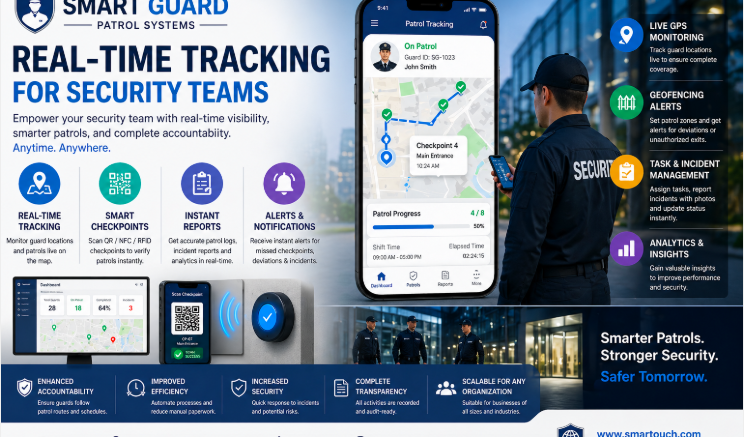
Security guards patrolling large facilities, warehouses, or residential estates face a common challenge: proving that every checkpoint was actually visited, on time, every shift. Paper logbooks and manual sign-off sheets are easy to falsify, hard to audit, and offer no real-time visibility. An RFID Guard Patrol System solves this by giving security operations verifiable, real-time proof of every patrol round. This article explains how RFID guard patrol systems work, why Singapore security operations are adopting them, and what to look for when choosing a solution.
What Is an RFID Guard Patrol System?
An RFID guard patrol system uses radio-frequency identification checkpoints installed at key locations around a site. Guards carry a handheld RFID reader or scanner device and tap it against each checkpoint tag during their rounds. The system automatically records the guard’s identity, the checkpoint location, and the exact timestamp, creating a verifiable digital trail of every patrol.
Unlike manual logbooks, an RFID system cannot be backdated or filled in after the fact. If a checkpoint is missed, supervisors are alerted immediately rather than discovering the gap during a post-incident review.
Why Singapore Security Operations Are Moving to RFID Patrol Systems
Security firms and in-house security teams in Singapore are under growing pressure to demonstrate compliance with client service level agreements and to respond faster to incidents. Manual patrol verification methods make both of these difficult to achieve consistently.
Common Problems with Manual Patrol Logs
- Paper logs can be filled in late or falsified, undermining patrol accountability.
- No real-time alert when a guard misses a checkpoint or patrol round.
- Difficult to compile accurate patrol reports for clients or audits.
- Limited visibility for supervisors managing guards across multiple sites.
- Time-consuming manual reconciliation between patrol logs and duty rosters.
Key Features of an RFID Guard Patrol System
| Feature | Description |
|---|---|
| RFID checkpoint tags | Fixed tags installed at key locations that guards scan during patrols |
| Handheld scanner devices | Portable readers guards carry to log checkpoint visits in real time |
| Real-time missed-checkpoint alerts | Notifies supervisors immediately if a scheduled checkpoint is skipped |
| GPS tracking integration | Some systems combine RFID with GPS to track guard movement between checkpoints |
| Incident reporting | Guards can log incidents, photos, or notes directly from the patrol device |
| Automated reporting | Generates patrol summary reports for clients, management, or audits |
Key Benefits for Security Operations
- Verifiable accountability — every checkpoint scan is time-stamped and tied to a specific guard, removing disputes over whether a patrol occurred.
- Faster incident response — real-time missed-checkpoint alerts let supervisors act immediately instead of discovering issues later.
- Stronger client confidence — automated patrol reports give clients concrete proof of service delivery.
- Reduced administrative work — patrol data is compiled automatically instead of manually transcribed from paper logs.
- Better multi-site oversight — supervisors can monitor patrol compliance across several properties from one dashboard.
How an RFID Guard Patrol System Works
1. Checkpoint Installation
RFID tags are installed at fixed locations around the site, such as entrances, stairwells, loading bays, and perimeter fencing.
2. Patrol Route Configuration
Supervisors define the expected patrol route, checkpoint sequence, and time intervals for each shift.
3. Guard Scanning
During patrols, guards scan each checkpoint tag with a handheld reader as they pass.
4. Real-Time Data Sync
Scan data is transmitted to the central system, either in real time or synced once the device reconnects to a network.
5. Monitoring and Alerts
Supervisors monitor patrol progress on a dashboard and receive alerts for missed or delayed checkpoints.
6. Reporting
Patrol history is compiled into reports for internal review or client submission.
RFID Patrol vs Manual Logbook Verification
| Factor | Manual Logbook | RFID Guard Patrol System |
|---|---|---|
| Verification accuracy | Easy to backdate or falsify | Time-stamped and tamper-resistant |
| Missed checkpoint detection | Discovered after the fact, if at all | Real-time alerts to supervisors |
| Reporting effort | Manual compilation from paper records | Automated report generation |
| Multi-site visibility | Limited, requires physical log collection | Centralised dashboard across all sites |
| Client confidence | Based on trust in paper records | Backed by verifiable digital data |
This comparison shows why more security companies are replacing paper-based verification with RFID technology to strengthen both accountability and client trust.
Best Practices for Implementing a Guard Patrol System
Map Checkpoints to Actual Risk Areas
Place RFID tags at locations that matter most for security, such as entry points, blind spots, and high-value asset areas.
Set Realistic Patrol Intervals
Configure checkpoint timing based on the size of the site and the number of guards on duty to avoid unrealistic expectations.
Train Guards on Device Use
Ensure guards are comfortable using handheld scanners and understand how to log incidents through the device.
Review Patrol Reports Regularly
Use the automated reports to identify patterns, such as recurring missed checkpoints, rather than only reviewing after an incident.
Key Takeaways
- RFID guard patrol systems replace easily falsified paper logs with verifiable, time-stamped checkpoint data.
- Security operations benefit from real-time missed-checkpoint alerts and faster incident response.
- Automated reporting reduces administrative work and strengthens client confidence.
- Multi-site security teams gain centralised visibility into patrol compliance.
- Careful checkpoint placement and guard training are key to a successful rollout.
Frequently Asked Questions
1. Can the system alert supervisors immediately if a checkpoint is missed?
Yes. Most RFID guard patrol systems send real-time alerts to supervisors when a scheduled checkpoint scan is missed or delayed.
2. Do guards need special training to use the handheld scanners?
Basic training is usually sufficient, as handheld RFID scanners are designed for quick, simple tap-and-go operation during patrols.
3. Can the system track guards across multiple properties?
Yes. Security companies managing several sites can monitor patrol compliance for all locations from a single centralised dashboard.
4. Is patrol data stored securely for audits?
Reputable systems store patrol data securely and make it easily retrievable for client audits or internal reviews.
5. Can guards report incidents through the same device?
Yes. Many RFID patrol devices allow guards to log incident notes or photos directly during their rounds, alongside checkpoint scans.
6. What happens if a handheld scanner loses network connection during a patrol?
Most devices store scan data locally and automatically sync it to the central system once connectivity is restored, so no patrol data is lost.
Conclusion
An RFID Guard Patrol System turns patrol verification from a matter of trust into a matter of record. By replacing paper logbooks with time-stamped, tamper-resistant checkpoint scans, security operations gain real-time visibility, faster incident response, and stronger proof of service delivery for clients. As security expectations in Singapore continue to rise, RFID-based patrol verification is becoming a standard requirement for modern security operations.
Need more information about the product? Click here: https://smartouch.com.sg/guard-patrol-system/
Smart Touch technology pte ltd , www.smartouch.com.sg +65-63964767, sales@smartouch.com.sg , www.smartouch.com.my +607-3889903 sales@smartouch.com.my