Top Benefits of Dormitory Management System Singapore for Manufacturing Plants
Managing employee accommodation is a significant operational challenge for manufacturing plants in Singapore, particularly those with large workforces that include migrant workers or employees from outside the island. While dormitory management might seem like a straightforward administrative task, the reality involves complex scheduling, compliance requirements, maintenance coordination, and resource allocation. For manufacturing facilities operating around the clock, dormitory management directly impacts employee productivity, safety, and overall business performance.
A dedicated dormitory management system can transform how manufacturing plants handle accommodation logistics. By automating and streamlining dormitory operations, these systems reduce administrative burden, improve compliance, and create better living conditions for residents. In Singapore’s competitive manufacturing sector, where talent retention and employee welfare are increasingly important, effective dormitory management has become a strategic business advantage.
Understanding Dormitory Management in Manufacturing Plants
Manufacturing plants often provide on-site or nearby accommodation to support their operational needs. This arrangement offers several advantages—employees can respond quickly to shift changes, reduce commute time, and maintain the flexibility required by round-the-clock manufacturing operations. However, managing dormitory facilities involves numerous interconnected processes that extend far beyond simply providing beds.
Dormitory management encompasses room allocation, occupancy tracking, maintenance requests, cleaning schedules, utility monitoring, visitor management, facility inspections, and resident communication. For large manufacturing facilities, this can involve managing hundreds of accommodation units and hundreds of residents simultaneously. Manual processes quickly become inefficient and error-prone, leading to operational bottlenecks and compliance gaps.
Singapore’s manufacturing plants must also navigate specific employment regulations, workplace safety standards, and housing requirements that apply to their resident workforce. Ensuring compliance while maintaining operational efficiency requires systematic processes and reliable documentation.
Common Challenges in Manual Dormitory Management
Manufacturing plants that rely on manual or spreadsheet-based dormitory management typically face several recurring problems:
- Room allocation inefficiencies: Without a centralised system, assigning rooms, tracking vacancies, and managing transfers becomes time-consuming and prone to double-bookings or errors.
- Maintenance coordination delays: Maintenance requests may get lost or delayed when managed through email, phone calls, or paper forms, leading to unresolved facility issues and resident dissatisfaction.
- Compliance documentation gaps: Tracking occupancy records, inspections, and safety certifications manually increases the risk of missing important compliance requirements.
- Poor visibility into resource usage: Without automated monitoring, it is difficult to track utility consumption, identify waste, or optimise resource allocation across dormitory facilities.
- Communication breakdowns: Resident concerns and administrative updates often get lost in uncoordinated communication channels, affecting resident satisfaction and operational responsiveness.
- Time-intensive administration: Staff members spend excessive hours on manual data entry, scheduling, and record-keeping instead of focusing on resident welfare and facility improvement.
These challenges accumulate, creating significant operational drag and preventing plant managers from making data-informed decisions about their dormitory operations.
Key Benefits of a Dormitory Management System
Streamlined Room Allocation and Occupancy Management
A dedicated dormitory management system provides real-time visibility into room availability, occupancy status, and resident assignments. Plant administrators can quickly allocate rooms based on predefined criteria—such as department, shift pattern, or accommodation preferences—without the confusion and errors that plague manual allocation processes.
The system automatically tracks check-ins and check-outs, maintaining accurate occupancy records essential for compliance and operational planning. This transparency helps plant managers optimise room utilisation and make informed decisions about dormitory capacity.
Efficient Maintenance and Facility Management
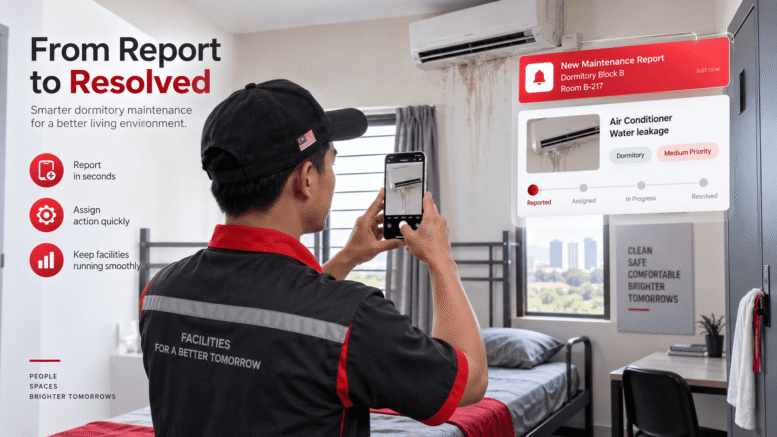
Residents can submit maintenance requests through a centralised platform, creating a documented trail of all facility issues. Plant maintenance teams receive requests immediately, can prioritise them based on urgency, and track completion status in real time. This organised approach significantly reduces response times and prevents minor issues from escalating into major problems.
The system also supports scheduled maintenance planning, helping facility managers maintain preventive maintenance records and plan inspections systematically rather than reactively.
Enhanced Compliance and Safety Documentation
Manufacturing plants must maintain comprehensive records demonstrating compliance with workplace safety standards, health regulations, and accommodation requirements. A dormitory management system automatically generates audit trails and maintains compliance documentation, making it straightforward to demonstrate adherence to Singapore regulations during inspections or audits.
Safety inspections, fire drills, and other regulatory requirements can be scheduled and documented within the system, ensuring nothing is overlooked.
Improved Resident Communication
A centralised communication platform ensures all residents receive important announcements simultaneously and consistently. Whether notifying residents about maintenance schedules, facility improvements, or policy changes, the system ensures clear, documented communication that reduces misunderstandings.
Residents can also access important information directly—such as facility rules, contact information for maintenance, or check-in procedures—reducing the administrative burden on staff while improving resident satisfaction.
Cost Control and Resource Optimisation
By automating administrative processes, a dormitory management system reduces the time required for manual data management and coordination. This frees staff to focus on higher-value activities that directly improve resident welfare and facility quality.
Better visibility into facility usage and resource consumption helps identify opportunities for cost savings—such as optimising utility usage or reducing inefficiencies in maintenance scheduling.
Data-Driven Decision Making
A dormitory management system generates valuable operational data—occupancy trends, maintenance patterns, resident satisfaction metrics, and resource usage statistics. Plant managers can analyse this data to identify improvement opportunities, allocate resources more effectively, and make strategic decisions about dormitory operations based on evidence rather than intuition.
How a Dormitory Management System Supports Manufacturing Operations
For manufacturing plants specifically, dormitory management systems offer operational benefits that extend beyond accommodation management itself. When employees have reliable, well-managed accommodation close to the plant, they experience lower stress and better work-life balance. This directly translates to improved attendance, reduced turnover, and more consistent workforce availability—critical factors in manufacturing environments where production schedules depend on reliable staffing.
The system also enables rapid response to operational changes. If a manufacturing plant needs to adjust shift patterns or temporarily accommodate additional workers during peak production periods, a dormitory management system allows quick reallocation of rooms and facilities without the delays and errors associated with manual processes.
For plants with significant migrant worker populations, the system can support compliance with employment regulations and accommodation standards, reducing administrative risk and demonstrating commitment to worker welfare standards.
Smart Touch Technology Singapore’s Dormitory Management Solution
Smart Touch Technology Singapore offers a comprehensive dormitory management system designed specifically to address the accommodation and operational challenges faced by manufacturing plants and other organisations in Singapore.
The solution provides a centralised platform for managing all aspects of dormitory operations—from room allocation and occupancy tracking through to maintenance coordination, compliance documentation, and resident communication. By integrating these functions into a single system, plant administrators gain complete visibility into dormitory operations and can respond quickly to issues or changes.
The system is built to support the specific operational needs of manufacturing environments, where efficiency, reliability, and compliance are essential. Whether managing a small dormitory facility or overseeing accommodation for hundreds of residents, the system scales to match your plant’s requirements.
Making the Transition to Systematic Dormitory Management
Implementing a dormitory management system represents a significant step toward operational excellence. The transition typically involves:
- Assessing current dormitory operations and identifying key challenges
- Selecting a system that aligns with your plant’s specific needs and scale
- Training staff on system use and new procedures
- Gradually transferring existing data into the system
- Monitoring the implementation and optimising processes based on early experience
While there is some effort required during implementation, most plants find that the operational benefits—reduced administrative burden, faster issue resolution, better compliance, and improved resident satisfaction—justify the investment quickly.
Conclusion
For manufacturing plants in Singapore managing employee accommodation, a dormitory management system transforms what is often a challenging, time-consuming administrative responsibility into an organised, efficient operation that directly supports business performance. By streamlining room allocation, maintenance coordination, and compliance documentation while improving resident communication, these systems deliver substantial operational benefits.
The ability to make data-informed decisions about dormitory operations, respond quickly to maintenance issues, and maintain reliable compliance documentation gives plant managers the tools they need to optimise accommodation management and support a productive, satisfied resident workforce.
Want to know more about this product? Click here to learn more about how Smart Touch Technology Singapore’s dormitory management system can improve your manufacturing plant’s accommodation operations.
Smart Touch technology pte ltd , www.smartouch.com.sg +65-63964767, sales@smartouch.com.sg , www.smartouch.com.my +607-3889903 sales@smartouch.com.my