Upgrade Growing SMEs with Face Recognition Access Control Singapore: Faster Reporting
Introduction
Singapore’s small and medium-sized enterprises (SMEs) are the backbone of the nation’s economy, representing over 99% of all businesses in the country. As these organisations grow, managing employee access, security, and operational efficiency becomes increasingly complex. Traditional access control methods—such as key cards, PIN codes, and manual attendance tracking—are no longer sufficient for businesses aiming to scale efficiently and securely.
One of the most significant challenges growing SMEs face is the lack of real-time visibility into who enters and exits their facilities, combined with the administrative burden of managing access credentials and generating comprehensive security reports. This is where modern face recognition access control technology becomes invaluable.
In Singapore’s competitive business environment, upgrading to intelligent access control systems is not just about security—it’s about gaining operational insights, improving reporting accuracy, and enabling faster decision-making. This article explores how face recognition access control can transform your SME’s operations and why faster reporting capabilities are essential for growing businesses.
Why Growing SMEs Need Modern Access Control Solutions
The Challenge of Scaling Security Operations
As SMEs expand, the administrative overhead of managing access becomes significant. Growing teams mean more employees, contractors, and visitors entering your premises. Managing physical keys, reissuing cards when staff leave, and manually tracking attendance creates operational inefficiencies that consume valuable resources.
Additionally, security concerns multiply with business growth. Understanding who has accessed sensitive areas, at what times, and for what purposes becomes critical for compliance, risk management, and operational safety. Manual tracking methods are prone to human error and leave gaps in security records.
The Limitations of Traditional Access Control
Traditional access control systems, such as card readers and PIN-based entry, present several drawbacks:
- Credential loss and theft: Cards can be lost, stolen, or duplicated, compromising security
- Manual reporting: Extracting access data requires time-consuming manual processes
- Delayed insights: Historical reporting often lags behind real-time events
- Limited audit trails: Tracking who accessed what and when becomes difficult without automated systems
- Administrative burden: Managing credentials for growing teams drains HR and operations resources
What is Face Recognition Access Control?
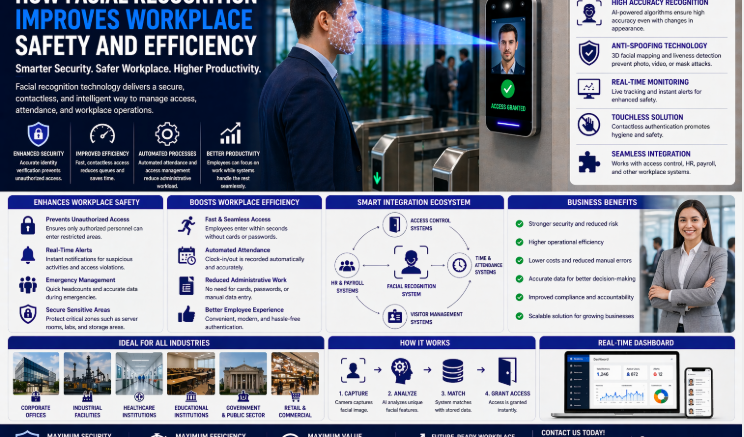
Face recognition access control is a biometric security solution that identifies individuals based on their unique facial features. Unlike card-based systems, face recognition relies on advanced algorithms to match a person’s face against a database of authorised users, enabling seamless and secure entry to controlled areas.
This technology operates in real-time, capturing facial data at entry points and instantly verifying whether the person is authorised to access that area. The process is fast, contactless, and leaves detailed digital records of every access event.
How It Works in Practice
When an employee or authorised visitor approaches a face recognition access point, the system captures their facial image, processes it in milliseconds, and compares it against the enrolled user database. If there is a match, access is granted and the event is logged. If there is no match, access is denied and an alert is generated.
This automated process eliminates the need for physical credentials, reduces friction for employees entering the workplace, and creates a complete audit trail of all access events.
Key Benefits of Face Recognition Access Control for Growing SMEs
Enhanced Security Without Credentials
Face recognition eliminates the vulnerabilities associated with physical cards or codes. Since your face cannot be lost, stolen, or shared, security is inherently stronger. This is particularly valuable for SMEs managing sensitive documents, intellectual property, or restricted areas.
Faster and More Accurate Reporting
One of the most significant advantages for growing SMEs is the automated reporting capability. Rather than manually compiling access logs from multiple systems, face recognition access control generates real-time reports that show:
- Who accessed each area and when
- How long individuals spent in restricted zones
- Patterns of unauthorised access attempts
- Compliance-ready audit trails for regulatory requirements
This faster reporting enables management to respond quickly to security incidents and make data-driven decisions about facility usage and security protocols.
Improved Operational Efficiency
Employees no longer need to carry cards, remember codes, or wait for manual authentication. The frictionless entry process speeds up employee flow, particularly during peak hours when many staff members are arriving or leaving. This seemingly small improvement compounds across daily operations, reducing bottlenecks and improving workplace experience.
Scalability as Your Business Grows
Adding new employees to a face recognition system is straightforward—simply enroll their facial data during onboarding. Removing access for departing staff is instantaneous. As your SME grows, the system scales effortlessly without the administrative complexity of managing physical credentials for hundreds of employees.
Compliance and Regulatory Support
Many industries in Singapore have specific security and compliance requirements. Face recognition systems generate comprehensive, timestamped records that support compliance documentation, internal audits, and investigations if required. This is especially valuable for SMEs in regulated sectors.
The Importance of Faster Reporting for Growing Businesses
Why Reporting Speed Matters
In a growing business, situations change rapidly. When a security incident occurs, management needs immediate access to accurate data to investigate and respond. Faster reporting means you can:
- Identify security incidents within minutes, not hours
- Track the movements of individuals during critical periods
- Verify compliance with access policies in real-time
- Generate reports for internal stakeholders or external auditors instantly
This speed of insight is a competitive advantage, particularly for SMEs that must operate lean and respond quickly to challenges.
Real-Time Alerts and Notifications
Modern face recognition systems provide instant notifications when unusual access patterns occur, such as attempts to access restricted areas outside normal hours or repeated failed recognition attempts. This enables security teams to respond proactively rather than reactively.
How Smart Touch Technology Face & Door Access Control Can Help
Smart Touch Technology Singapore offers a comprehensive face recognition access control solution through its Face & Door Access system. This solution is specifically designed to meet the needs of growing businesses in Singapore.
The Face & Door Access system integrates facial recognition technology with intelligent door control, enabling businesses to secure their premises while maintaining detailed, real-time access records. The system is built to support growing organisations, with scalable infrastructure that grows alongside your business.
Key capabilities include automated access granting based on facial recognition, detailed audit trails of all access events, and reporting functionality that provides the faster insights your growing business needs. Whether you need to secure a single office entrance or multiple access points across several facilities, the system can be configured to match your requirements.
For SMEs looking to upgrade from traditional access control methods, Smart Touch Technology provides a professional, reliable solution that addresses the specific challenges of managing security and compliance as your business expands.
Implementing Face Recognition Access Control in Your SME
Planning Your Implementation
Before implementing a face recognition system, consider your specific needs:
- How many access points require control?
- How many employees and visitors need to be enrolled?
- Which areas of your facility require restricted access?
- What reporting requirements do you have?
A clear implementation plan ensures the system addresses your actual business needs and integrates smoothly with your existing operations.
Enrollment and Training
Enrolling employees in a face recognition system is straightforward. Typically, this involves capturing a high-quality facial image during onboarding. Staff should be given clear information about how the system works and what to expect when using it. Most employees adapt quickly to contactless, frictionless entry.
Ongoing Management and Maintenance
Once implemented, a face recognition system requires minimal ongoing management compared to traditional credential-based systems. Updates to the system are usually automated, and enrolment of new staff is a simple, fast process.
Addressing Common Concerns
Accuracy and Reliability
Modern face recognition technology is highly accurate and reliable. Systems are designed to perform consistently across varying lighting conditions and facial presentations. For SMEs, this reliability means fewer false denials or unauthorised access incidents.
Privacy Considerations
While face recognition systems capture facial data, they do so for the specific purpose of access control and security. Businesses should ensure they communicate clearly with employees about how facial data is stored and used, maintaining transparency and trust.
The Competitive Advantage for Singapore SMEs
In Singapore’s fast-paced business environment, efficiency and security are competitive necessities. SMEs that upgrade to intelligent access control systems gain several advantages:
- Faster response times to security incidents through real-time reporting
- Reduced administrative overhead, freeing staff for higher-value work
- Enhanced security posture that protects assets and intellectual property
- Scalable systems that support business growth without major reinvestment
- Professional infrastructure that supports compliance and audits
These advantages compound over time, contributing to more efficient, secure, and scalable operations.
Next Steps for Your SME
If your growing SME is ready to upgrade from traditional access control methods, the time to act is now. Modern face recognition access control technology is mature, reliable, and specifically designed to support businesses like yours.
Want to know more about this product? Click here to learn more about Smart Touch Technology’s Face & Door Access Control solution and how it can support your business growth.
Conclusion
As Singapore SMEs continue to grow and compete in an increasingly demanding market, upgrading access control systems is a smart investment. Face recognition technology eliminates the inefficiencies of traditional methods while providing faster, more accurate reporting that enables better decision-making.
The combination of enhanced security, improved operational efficiency, and real-time reporting insights makes face recognition access control an essential upgrade for growing businesses. Smart Touch Technology’s Face & Door Access system provides a professional, reliable solution tailored to the needs of Singapore organisations seeking to balance security, efficiency, and scalability.
By taking action now, your SME can position itself for sustainable growth with security infrastructure that supports your expansion every step of the way.
Smart Touch technology pte ltd , www.smartouch.com.sg +65-63964767, sales@smartouch.com.sg , www.smartouch.com.my +607-3889903 sales@smartouch.com.my