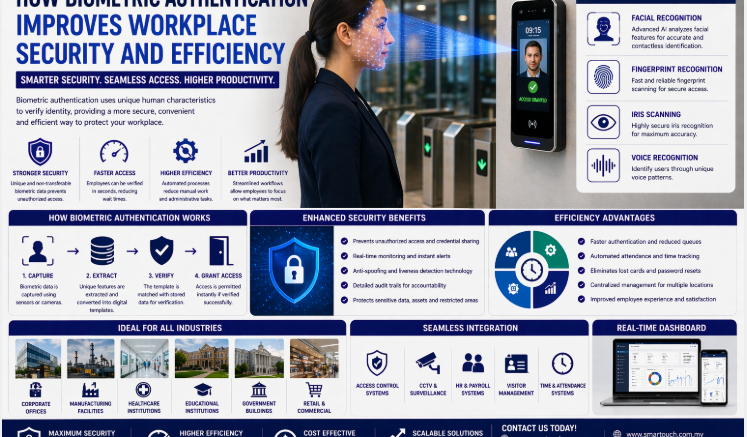
Data centres, server rooms, R&D labs, and other high-security facilities in Singapore need access control that goes beyond a standard office turnstile. A high-security turnstile with integrated face recognition and door access control provides layered, verifiable protection suited to environments where a single unauthorised entry could be a serious security or compliance failure.
This article explains what sets high-security turnstile systems apart, how face and door access integration strengthens protection, and what facilities should look for in 2026.
What Makes a Turnstile “High-Security”?
Standard turnstiles control pedestrian flow and may include basic card or PIN access. High-security turnstiles add multiple layers: full-height or optical barrier designs that prevent tailgating, integration with door access control for a second verification point, and facial recognition that ties every entry to a verified, non-transferable identity. Together, these layers are designed to close the specific gaps that standard turnstiles leave open, particularly around one person’s credential being used to let a second, unauthorised person through behind them.
Why Face and Door Integration Matters
A turnstile alone controls the lobby entry point, but sensitive facilities often need to restrict access at multiple points within the building — server rooms, equipment racks, or restricted floors. Integrating face recognition turnstiles with door access control ensures that identity verification is consistent from the moment someone enters the building through to the specific restricted zones they’re authorised to access.
Key Benefits for High-Security Facilities
| Benefit | Impact |
|---|---|
| Anti-tailgating protection | Full-height or optical barriers prevent unauthorised entry alongside an authorised person |
| Layered verification | Face recognition at the turnstile and door access control at restricted zones |
| Non-transferable identity | Facial verification cannot be shared, unlike cards or PINs |
| Complete audit trail | Every entry point logs verified identity and timestamp |
| Zone-specific restriction | Access can be limited precisely to each individual’s authorised areas |
How the System Works: A Step-by-Step Guide
- Enrolment and permission mapping — Authorised personnel are enrolled with facial profiles linked to specific zone permissions.
- Perimeter verification — At the high-security turnstile, facial recognition verifies identity before the barrier releases.
- Zone-level door access — Within the facility, door access control re-verifies identity or credentials at each restricted zone.
- Anti-tailgating detection — Sensors detect and alert on any attempt to pass through with or immediately behind another individual.
- Centralised logging — All entry and access events across the turnstile and internal doors are logged to a central security system.
Best Practices for High-Security Deployments
Map access permissions precisely by role and clearance level, avoiding blanket access that undermines the purpose of zone-level control. Test anti-tailgating detection thoroughly under real foot-traffic conditions before go-live. Integrate turnstile and door access logs into a single security monitoring dashboard rather than managing them separately. Review and update access permissions immediately when personnel change roles or leave the organisation.
Feature Comparison: Standard vs. High-Security Turnstiles
- Standard turnstile: Basic barrier, card or PIN access, limited anti-tailgating protection.
- High-security turnstile: Full-height or optical barriers, facial recognition, integrated door access, strong anti-tailgating detection.
- High-security turnstile with door integration: Adds zone-level verification beyond the perimeter, suited to facilities with multiple restricted areas.
Choosing the Right System for 2026
Facilities should evaluate anti-tailgating performance under realistic conditions, not just vendor specifications. Recognition speed and accuracy should be tested against the facility’s actual traffic patterns and lighting. Integration capability with existing door access control and broader security systems is essential for facilities with multiple restricted zones, and reporting tools should support the level of audit detail required for compliance or client assurance purposes.
Cost and ROI Considerations
High-security turnstile systems typically carry a higher upfront cost than standard turnstiles, reflecting the additional anti-tailgating hardware, facial recognition capability, and door integration involved. For facilities handling sensitive data, equipment, or intellectual property, the return on investment is best measured against the cost of a single serious security breach — including potential regulatory penalties, client trust damage, and operational disruption — which typically far exceeds the cost of the security upgrade itself.
Real-World Application in High-Security Singapore Facilities
Data centres, financial institutions, and R&D facilities in Singapore have been steadily adopting layered turnstile and door access systems as part of broader security certifications and client assurance requirements, particularly where clients or regulators require demonstrable physical security controls. Facility security teams often highlight that centralised logging across the turnstile and internal doors — rather than managing each system separately — is what turns a collection of security devices into a genuinely audit-ready security architecture.
Key Takeaways
- High-security turnstiles combine physical anti-tailgating barriers with facial recognition verification.
- Integration with door access control extends verified identity to internal restricted zones.
- Centralised logging across all access points strengthens audit and compliance capability.
- Access permissions should be reviewed and updated promptly as personnel roles change.
Conclusion
For facilities where a single unauthorised entry carries serious consequences, a high-security turnstile with integrated face and door access control provides the layered, verifiable protection that standard access systems can’t match. As Singapore facilities continue to raise security expectations into 2026, combining anti-tailgating barriers, facial recognition, and zone-level door integration offers a comprehensive, audit-ready approach to perimeter and internal access control.
Frequently Asked Questions
1. What is anti-tailgating detection? It’s a feature that detects and alerts when more than one person attempts to pass through a turnstile on a single verified entry, preventing unauthorised piggybacking.
2. How does door access integration differ from the turnstile alone? The turnstile controls building perimeter entry, while integrated door access control extends identity verification to specific restricted zones within the facility.
3. Is facial recognition accurate enough for high-security use? Modern facial recognition systems achieve high accuracy rates suited to high-security applications, though performance should be validated under the facility’s specific conditions.
4. Can access permissions be customised per individual? Yes, zone-level permissions can typically be configured individually based on role, clearance, or department.
5. How is entry and access data logged for compliance purposes? Centralised logging captures every entry event across the turnstile and internal doors, with timestamps and verified identity, supporting compliance and incident investigation needs.
6. Can a high-security turnstile system be retrofitted into an existing building? In most cases, yes — systems can typically be integrated with existing door access infrastructure, though the extent of retrofitting depends on the building’s current security architecture and should be assessed by a qualified integrator.
Want to know more about this product? Click here: https://smartouch.com.sg/face-and-door-access/
Smart Touch technology pte ltd , www.smartouch.com.sg +65-63964767, sales@smartouch.com.sg , www.smartouch.com.my +607-3889903 sales@smartouch.com.my