Why Education Campuses Choose Face Recognition Access Control Singapore for Reduced Waiting Time
Introduction
Educational institutions across Singapore face a unique challenge when it comes to campus access and security. With thousands of students, staff members, and visitors moving through campus gates and buildings daily, traditional access control methods—such as ID card scanning or manual verification—often create bottlenecks that waste valuable time and frustrate the campus community.
Long queues at entry points not only disrupt the flow of daily activities but also detract from the learning experience and operational efficiency. Schools, polytechnics, and universities are increasingly turning to modern solutions that streamline access while maintaining robust security standards. Face recognition access control has emerged as a practical, efficient answer to this widespread problem in Singapore’s education sector.
This article explores why education campuses are adopting face recognition technology, how it addresses waiting time challenges, and how institutions can implement it effectively to improve their operations.
The Challenge of Access Control in Educational Institutions
Volume and Complexity of Campus Movement
Education campuses operate differently from typical commercial or corporate environments. On any given day, a single institution may need to manage the access of hundreds or thousands of individuals across multiple entry points, buildings, and secure areas. This includes:
- Students entering and leaving campus at different times
- Staff members accessing various facilities throughout the day
- Visitors, contractors, and delivery personnel requiring controlled access
- Events and activities that bring additional temporary occupants to campus
Managing this volume with traditional access methods places significant strain on security personnel and infrastructure.
Inefficiencies of Traditional Access Methods
Conventional access control systems—such as ID card readers or manual gate checks—create several operational challenges:
- Queue formation: Peak hours result in long lines at entry and exit points, causing delays
- Lost or forgotten credentials: Students and staff frequently misplace ID cards, requiring replacement procedures
- Manual verification overhead: Security personnel must physically check each person, which is time-consuming and prone to human error
- Limited scalability: As campuses grow, traditional systems struggle to handle increased throughput
- Security vulnerabilities: ID cards can be shared, forged, or used by unauthorised individuals
These inefficiencies directly impact the campus experience and operational costs for educational institutions.
How Face Recognition Access Control Reduces Waiting Time
Instant Identification and Verification
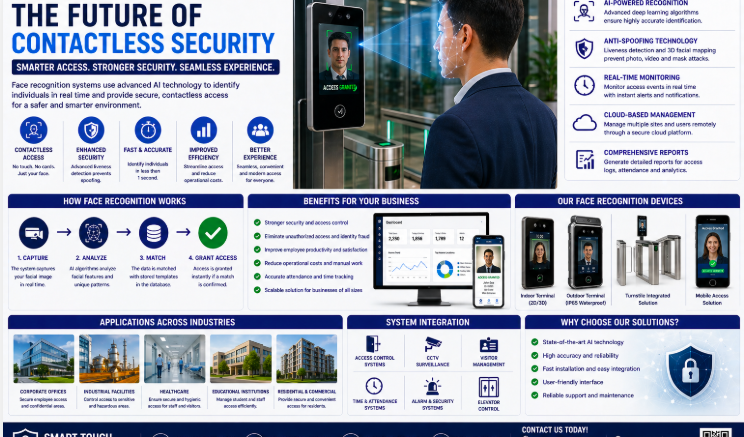
Face recognition technology works by capturing and analysing facial features at entry points and comparing them against an authorised database in real time. This process typically takes only seconds, compared to the minutes required for manual ID verification or card-based systems.
When implemented across multiple campus access points, this speed multiplies, allowing hundreds of individuals to pass through during peak hours with minimal congestion. Students and staff can move through gates and building entrances smoothly, without stopping to present credentials or wait for manual verification.
Elimination of Physical Credential Dependencies
One of the most significant advantages of face recognition is that it removes the need for individuals to carry or present physical access credentials. Students no longer need to worry about lost ID cards, and security personnel do not spend time managing replacement processes or dealing with forgotten credentials at entry points.
This simplification streamlines the entire access experience and reduces delays caused by credential-related issues.
Parallel Processing at Multiple Entry Points
Educational campuses typically have multiple access points—main gates, side entrances, building entry doors, and laboratory access. Face recognition systems can be deployed across all these points simultaneously, allowing different groups to enter different areas concurrently. This parallel processing significantly reduces the bottlenecking effect that occurs with centralised access control.
Benefits Beyond Reduced Waiting Time
Enhanced Security and Access Control
While speed is a key advantage, face recognition also strengthens campus security. The technology ensures that only authorised individuals gain access to specific areas, reducing the risk of unauthorised entry, credential sharing, or impersonation. This is particularly important for campuses that have secure laboratories, research facilities, or restricted administrative areas.
Improved Operational Data and Insights
Face recognition systems generate detailed records of who accessed which areas and when. Educational institutions can use this data to:
- Track attendance patterns and campus usage
- Identify peak traffic times and optimise resource allocation
- Generate reports for compliance and auditing purposes
- Plan future expansions or improvements based on actual usage data
Contactless Access and Hygiene Considerations
Particularly relevant in Singapore’s current context, face recognition is a contactless technology. Unlike card readers or keypads that many individuals touch throughout the day, facial recognition systems eliminate shared touch points, supporting better hygiene and reducing the transmission of germs—an important consideration for any educational setting.
Implementation Considerations for Singapore Education Campuses
Enrolment and Database Setup
Before deploying face recognition, educational institutions need to establish a comprehensive database of authorised users. This involves capturing facial data from students, staff members, and regular visitors during an enrolment process. For most campuses, this can be done efficiently during registration periods or through dedicated enrolment days.
Integration with Existing Systems
Many educational institutions already have access control infrastructure in place, such as gates, door locks, and monitoring systems. A properly designed face recognition solution should integrate with these existing systems rather than requiring a complete replacement, minimising disruption and investment.
Privacy and Data Protection
Singapore has established clear data protection regulations, including the Personal Data Protection Act (PDPA). Educational institutions must ensure that any face recognition system complies with these requirements, including obtaining appropriate consent, securing biometric data, and implementing clear data retention and deletion policies. It is advisable to review the latest guidance from the Personal Data Protection Commission (PDPC) to ensure full compliance.
User Acceptance and Change Management
Introducing new access control methods requires clear communication with the campus community. Educational institutions should explain how the technology works, address privacy concerns transparently, and ensure all stakeholders understand the benefits. Training for staff and clear signage for students help ensure smooth adoption.
Smart Touch Technology’s Face & Door Solution
What It Offers
Smart Touch Technology Singapore provides face recognition access control solutions specifically designed for Singapore businesses and organisations. The Face & Door product is engineered to streamline access control across campuses, buildings, and secure areas by combining reliable facial recognition with intuitive door access management.
The solution is built to handle the high throughput and complex access requirements typical of educational campuses, whilst maintaining the security, accuracy, and compliance standards expected in Singapore’s institutional environment.
How It Addresses Campus Challenges
Smart Touch’s Face & Door system addresses the specific pain points that education campuses face:
- Reduced waiting time: Fast facial recognition processing allows large numbers of users to pass through access points quickly
- Scalable deployment: The system can be deployed across multiple entry points and buildings, growing with your campus
- Integration capability: Works with existing door locks, gates, and access control infrastructure
- Reliable performance: Engineered to function effectively in Singapore’s climate and operational environment
- Local support: Being a Singapore-based provider, Smart Touch offers local technical support and customer service
Getting Started with Face Recognition Access Control
Assessment and Planning
The first step for any educational institution is to assess current access control challenges, identify key entry points, and understand the volume of daily users. This assessment helps determine the scale and scope of a face recognition deployment.
Pilot Implementation
Many campuses benefit from starting with a pilot programme at one or two key entry points. This allows staff and users to become familiar with the technology, identify any operational adjustments needed, and demonstrate value before full campus-wide deployment.
Phased Rollout
A phased approach—expanding from initial pilot areas to additional buildings and entry points over time—allows institutions to manage costs, maintain operational continuity, and refine processes based on real-world experience.
Conclusion
Education campuses across Singapore face genuine challenges in managing access for large numbers of users whilst maintaining security and operational efficiency. Long waiting times at entry points frustrate students and staff, detract from the learning experience, and strain institutional resources.
Face recognition access control offers a practical, modern solution that significantly reduces waiting times while enhancing security and providing valuable operational insights. By eliminating the need for physical credentials and enabling instant verification across multiple access points, this technology streamlines campus operations and improves the experience for the entire campus community.
For educational institutions ready to modernise their access control systems, face recognition represents a worthwhile investment that addresses both immediate operational challenges and long-term scalability needs.
Want to know more about this product? Click here to explore how Smart Touch Technology’s Face & Door solution can transform access control at your education campus.
Smart Touch technology pte ltd , www.smartouch.com.sg +65-63964767, sales@smartouch.com.sg , www.smartouch.com.my +607-3889903 sales@smartouch.com.my