Compare Barrier Gate System Singapore Options for Facility Management Teams in Singapore
Introduction
Facility management in Singapore has evolved significantly over the past decade. Today’s facility managers face increasing demands to enhance security, streamline operations, and maintain professional standards across their premises. One critical component of modern facility management is the barrier gate system—a fundamental infrastructure element that controls vehicle and pedestrian access to parking areas, compounds, and restricted zones.
Whether you manage a commercial office building, industrial complex, residential development, or hospitality venue, selecting the right barrier gate system is essential. The wrong choice can lead to operational inefficiencies, security vulnerabilities, maintenance headaches, and frustrated staff and visitors. Conversely, the right system can dramatically improve access control, enhance safety, reduce unauthorised entry, and create a more professional environment.
This guide explores the key considerations for choosing a barrier gate system in Singapore and introduces how modern solutions can address your facility management challenges.
Why Barrier Gate Systems Matter for Singapore Facilities
Singapore’s business landscape is fast-paced and highly competitive. Facility managers must maintain high standards of security and operational efficiency whilst managing costs effectively. A well-designed barrier gate system serves multiple critical functions:
- Access Control: Manages who can enter and exit your facility, preventing unauthorised access to sensitive areas
- Security Enhancement: Acts as a visible deterrent to unauthorised vehicles and provides a controlled entry point
- Traffic Management: Regulates vehicle flow, reduces congestion, and improves parking area safety
- Visitor Management: Allows facilities to monitor and record all vehicle movements, enhancing accountability
- Professional Image: Projects a secure, well-managed environment to clients, tenants, and employees
Singapore’s property market is dynamic, and facility standards are continuously rising. Property managers and facility teams are expected to deliver secure, efficient, and professionally managed environments. A modern barrier gate system is no longer a luxury—it’s a necessity for maintaining competitiveness and meeting stakeholder expectations.
Understanding Different Barrier Gate System Types
Swing Barriers
Swing barriers operate using a two-arm swinging mechanism that opens to allow vehicle passage and closes when not in use. These systems are commonly seen at parking entrances and compounds.
Advantages include straightforward installation in standard spaces and relatively simple operation. However, swing barriers require adequate space on both sides of the barrier to operate effectively, making them unsuitable for tight or narrow entrances. They also have a slower cycle time compared to some alternative systems.
Sliding Barriers
Sliding barriers move horizontally to open and close, sliding parallel to the entrance. These are ideal for locations where space is limited or where a more compact solution is required.
Sliding barriers are excellent for narrow driveways or tight compounds where swing barriers cannot operate effectively. They also provide a sleek, modern appearance. The trade-off is that they require a clear horizontal space and may be more expensive than swing barrier systems.
Automatic Rising Bollards
Rising bollards are cylindrical posts that rise from the ground when activated and retract when access is granted. These are typically used in high-security applications or pedestrian-focused areas.
Bollards offer exceptional security and are particularly effective at preventing forced vehicle entry. They work well in mixed-use environments where both vehicles and pedestrians need access. However, they require underground installation and regular maintenance, and the initial investment is typically higher.
Key Considerations When Selecting a Barrier Gate System
Space and Site Layout
Before selecting any system, assess your facility’s physical layout. Measure the entrance width, evaluate available space on either side of the entrance, and consider any obstacles such as pillars, services, or landscaping. This assessment will immediately eliminate certain options and guide your decision towards systems that are practical for your site.
Traffic Volume and Cycle Time
How many vehicles need to pass through your facility during peak hours? High-traffic facilities require barrier systems with fast cycle times—the time it takes to open, allow passage, and close. A slow system can create bottlenecks and frustrate staff and visitors.
Integration with Existing Systems
Modern facility management relies on integrated technology. Your barrier gate system should integrate seamlessly with your access control platform, parking management software, visitor management system, and any other security infrastructure already in place. Systems that operate in isolation create additional work for facility staff and reduce overall efficiency.
Reliability and Maintenance Requirements
Barrier systems operate continuously throughout the day. System downtime can disrupt operations entirely. Consider the reputation of the supplier, availability of maintenance support in Singapore, spare parts availability, and the expected lifespan of critical components.
Security Features
Evaluate the security capabilities of different systems. Can the system detect and prevent forced entry attempts? Does it log all vehicle movements? Can it be integrated with CCTV or other security monitoring systems? Does it support different access levels for staff, tenants, and visitors?
Cost Considerations
Budget constraints are real, but approach cost decisions strategically. The cheapest barrier gate system may result in high maintenance costs, frequent downtime, or insufficient security features. Consider total cost of ownership—including installation, maintenance, spare parts, software licensing, and eventual replacement—rather than focusing solely on the upfront purchase price.
Compliance and Safety Standards
Ensure that any barrier gate system meets relevant safety standards and can be operated in compliance with Singapore workplace safety guidelines. The system should include appropriate safety features such as sensors to detect obstacles, emergency stop functions, and protection against crushing or entrapment hazards.
Common Challenges Facility Managers Face
Many Singapore facility managers encounter similar challenges with barrier gate systems:
- Frequent Breakdowns: Unreliable systems create operational disruptions and frustrate users
- Slow Response Times: Systems that operate too slowly create traffic bottlenecks and queues
- Poor Integration: Systems that don’t integrate with other facility management platforms create manual workarounds and duplicate data entry
- Limited Visibility: Lack of real-time data about vehicle movements and access patterns
- High Maintenance Costs: Systems with poor reliability result in unexpected repair bills and reduced lifespan
- Inadequate Reporting: Difficulty tracking access history, generating reports, or identifying patterns
These challenges underscore the importance of selecting a robust, well-integrated system from the outset rather than attempting to patch together unreliable components.
How Smart Touch Technology Can Help
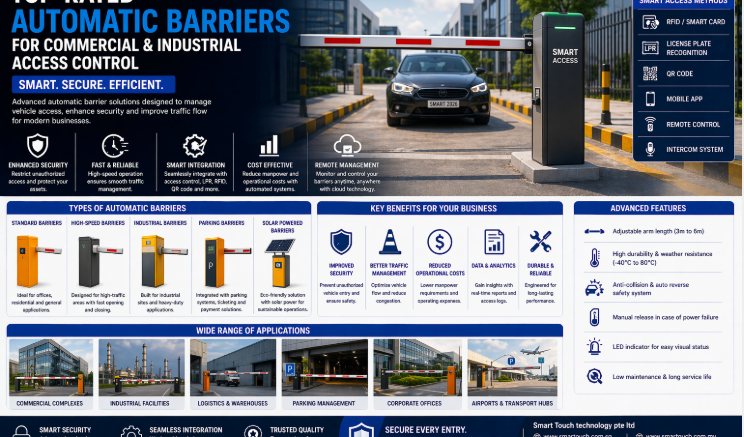
Smart Touch Technology Singapore specialises in access control and facility management solutions tailored for Singapore businesses. Their barrier gate systems are designed to address the specific challenges faced by facility managers in Singapore’s dynamic business environment.
Smart Touch’s barrier solutions offer the integration, reliability, and ease of management that modern facilities require. By combining robust hardware with intelligent software, Smart Touch enables facility teams to manage access control efficiently, monitor vehicle movements in real time, generate comprehensive reports, and integrate seamlessly with existing facility management infrastructure.
Whether your facility requires a swing barrier for standard applications, a sliding barrier for space-constrained environments, or a more sophisticated access control solution, Smart Touch Technology can provide options tailored to your specific needs and operational requirements.
For more information about the product, please click here: https://smartouch.com.sg/barrier/
Making Your Selection
Choosing a barrier gate system should be a strategic decision based on your facility’s specific requirements, not simply the lowest price. Engage with suppliers who understand Singapore’s facility management landscape, offer strong local support, and can demonstrate how their systems will integrate with your existing operations.
Request site assessments from qualified providers, ask for references from similar facilities, and clarify exactly what support and maintenance services are included after installation. A barrier gate system typically operates for many years, so investing time in making the right selection decision will pay dividends in reliability, efficiency, and reduced operational headaches.
Conclusion
Barrier gate systems are fundamental infrastructure for modern facility management in Singapore. By understanding the different system types, evaluating your specific facility requirements, and prioritising integration, reliability, and professional support, you can select a solution that enhances security, streamlines operations, and meets your facility’s needs for years to come.
The right barrier gate system is an investment in your facility’s security, efficiency, and professional reputation. Take the time to compare your options carefully, and partner with a provider who understands Singapore’s facility management environment and can deliver ongoing support.
Smart Touch technology pte ltd , www.smartouch.com.sg +65-63964767, sales@smartouch.com.sg , www.smartouch.com.my +607-3889903 sales@smartouch.com.my